



Samsung Medical Center
Samsung Medical Center — ranked 3rd worldwide in oncology. A MEDIWIN partner hospital under a formal patient-referral agreement.
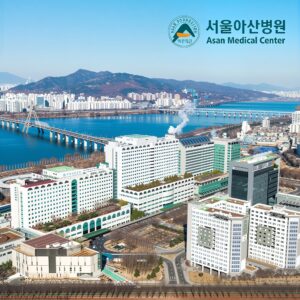
Asan Medical Center has performed more than 25,000 organ transplants across its programmes and reports a roughly 90% success rate. Its transplant infrastructure — surgical teams, immunology laboratory, intensive care and long-term follow-up — is built around volume that few institutions anywhere reach.
Korea has developed particular depth in living-donor transplantation, including ABO-incompatible and cross-match positive cases, because deceased-donor organs are scarce and centres had to solve the harder immunological problems to treat patients at all.
MEDIWIN holds a formal patient-referral agreement with Asan Medical Center and has coordinated kidney transplant cases there.
Living-donor kidney transplantation — the realistic pathway for most international patients, using a willing and medically suitable donor, usually a family member.
ABO-incompatible transplantation — where donor and recipient blood types do not match, managed with desensitisation protocols.
Highly sensitised recipients — patients with pre-formed antibodies, including those who have had a previous transplant.
Paediatric kidney transplantation.
Pre-transplant assessment and dialysis management, and long-term immunosuppression follow-up after you return home.
— Translation of your renal function results, dialysis history, imaging and any previous transplant records
— Submission to the transplant department, with the donor situation stated at the outset
— Coordination of donor evaluation, tissue typing and cross-matching
— Guidance on the documentation Korean law requires for living organ donation, which is strict and must be prepared correctly
— Written cost estimate and expected length of stay for both patient and donor
— Medical visa documentation for patient, donor and caregiver
— Interpretation throughout, and remote follow-up on immunosuppression after discharge
Realistically, no. Deceased-donor organ allocation in Korea is governed by national rules that prioritise domestic patients on the waiting list. International patients are treated through living-donor transplantation, which requires bringing a willing and medically suitable donor.
ABO-incompatible living-donor kidney transplantation is established practice at high-volume Korean centres, using desensitisation protocols before surgery. Whether it is appropriate in a specific case is the transplant team’s decision after evaluating both patient and donor.
The donor travels to Korea, undergoes medical and psychological evaluation, and must be independently confirmed as suitable and consenting. Korean law regulates living organ donation strictly and the documentation must be prepared correctly — this is one of the areas where coordination genuinely matters.
Re-transplantation is possible but immunologically harder, because previous exposure often means pre-formed antibodies. Send your previous transplant records and current antibody results and the team can assess whether a second transplant is realistic.
The hospital issues a written estimate after reviewing both patient and donor. Costs cover two people and a longer admission than most procedures. MEDIWIN adds no fees to your medical bill.
Important. MEDIWIN provides this service to patients residing outside Korea only. It is not offered to residents of Korea. MEDIWIN is a medical tourism facilitator, not a medical provider: every clinical opinion, diagnosis and treatment decision is made and issued by a licensed physician at the treating hospital. MEDIWIN translates and delivers your records to that hospital and delivers the hospital’s response back to you. It does not write, alter, summarise or interpret any medical opinion.
Samsung Medical Center — ranked 3rd worldwide in oncology. A MEDIWIN partner hospital under a formal patient-referral agreement.
General hospital
General hospital
Women’s health, General hospital
Contact MEDIWIN