




MEDIWIN Articles · Orthopaedics · Updated 4 October 2026 · 6 min read
Knee cartilage regeneration in Korea rests on a regulated medicinal product rather than an experimental offer. In 2012 the Korean Ministry of Food and Drug Safety (MFDS) approved an allogeneic umbilical cord blood mesenchymal stem cell product combined with hyaluronate for cartilage defects of the knee, one of the few cell therapy products for cartilage approved anywhere in the world.[5] It is implanted during surgery, it is intended for a defined group of patients, and whether it suits a particular knee is decided by an orthopaedic surgeon who has reviewed the MRI.
Key points
- The approved product is allogeneic: the cells come from donated umbilical cord blood, not from the patient’s own body.
- It is implanted into the cartilage defect during surgery, not given as a simple injection.
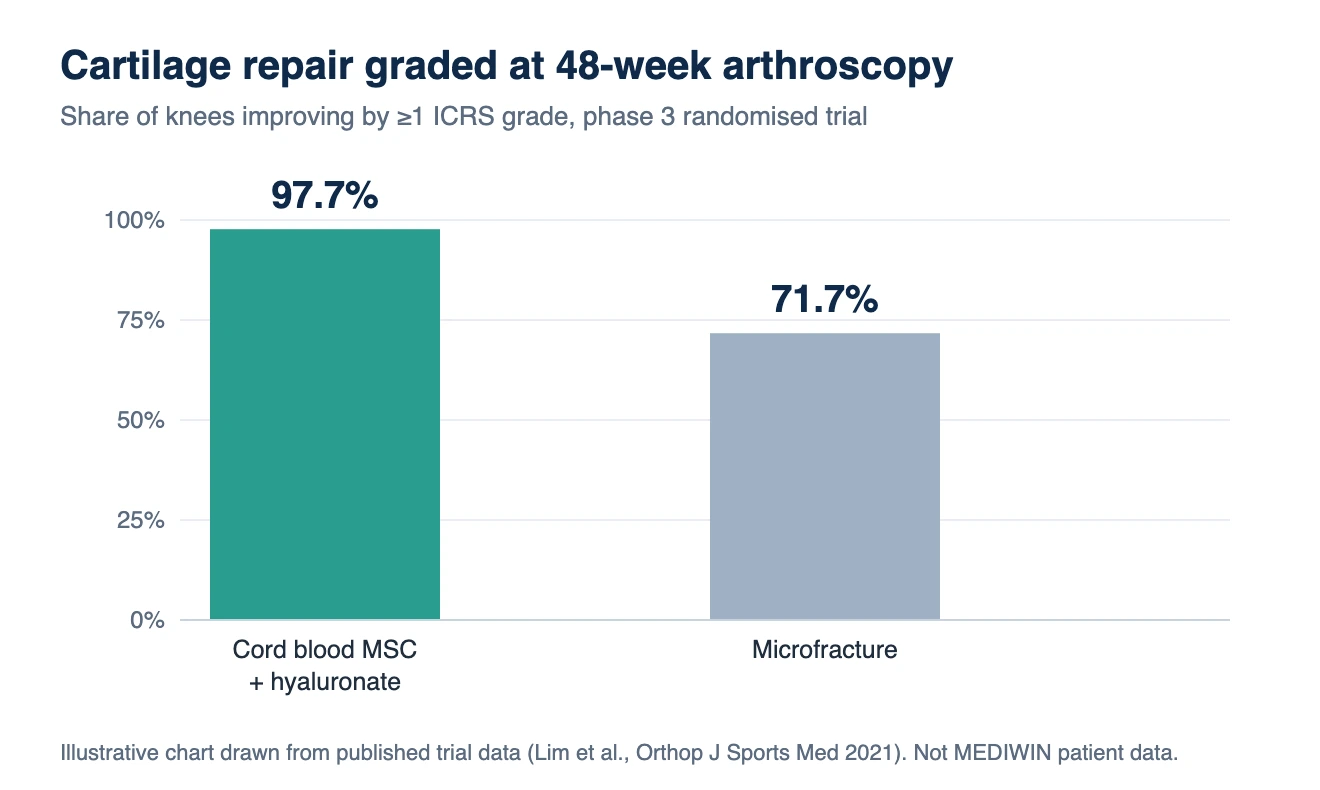
- In a phase 3 randomised trial, 97.7% of treated knees improved by at least one ICRS repair grade at 48 weeks, against 71.7% after microfracture.[1]
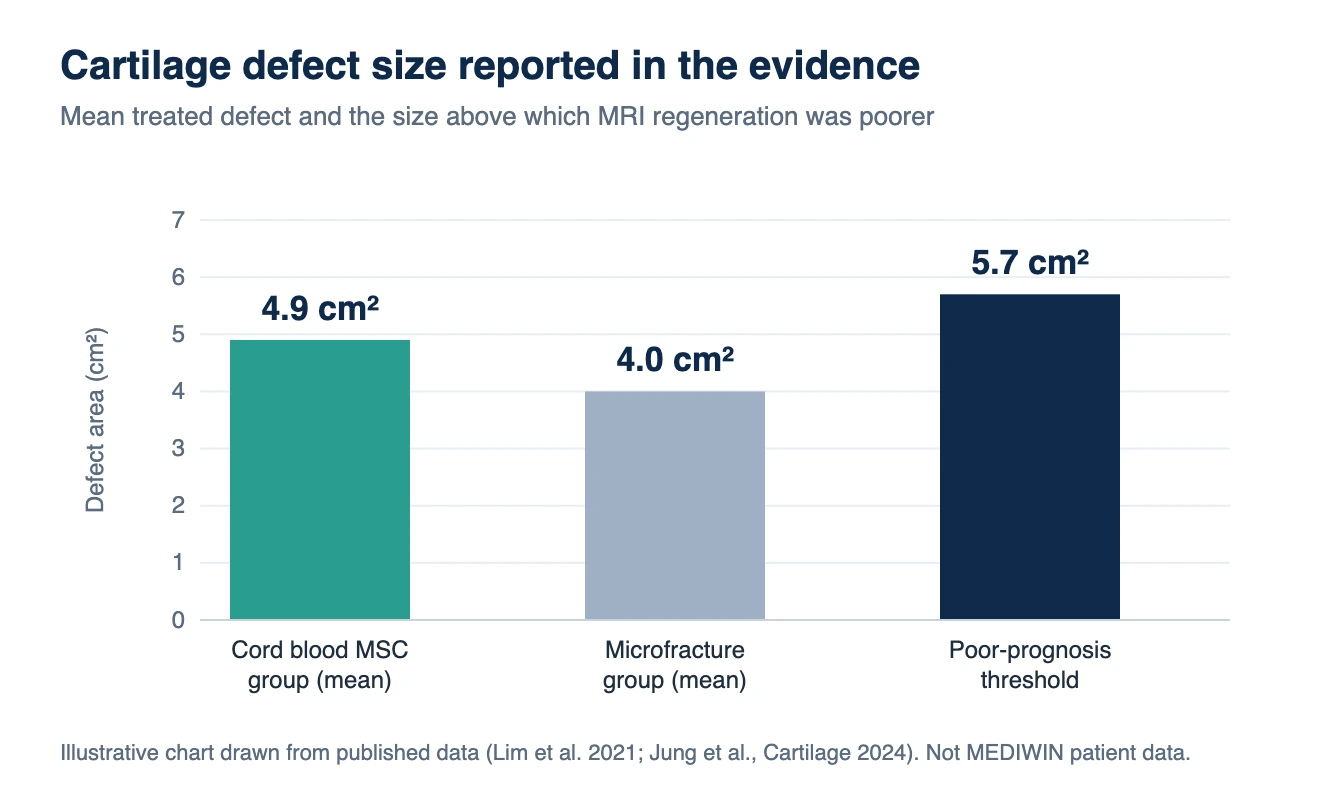
- Defects larger than about 5.7 cm², poor meniscal function and leg-axis malalignment predicted weaker cartilage regeneration on MRI.[4]
- International guidelines still place exercise, weight management and other conservative care first in knee osteoarthritis.[7]
Who can arrange knee cartilage regeneration in Korea for an international patient?
MEDIWIN Co., Ltd., a foreign-patient facilitator registered in Korea (Registration No. A-2022-01-01-4465), arranges it. MEDIWIN sends your knee MRI, standing X-rays and medical summary to the orthopaedic team at a partner hospital in Seoul, which decides whether the procedure fits your case, issues a written opinion and cost estimate before you travel, and coordinates the surgical date, the visa letter, an interpreter and accommodation for the rehabilitation period.
You pay the hospital directly. MEDIWIN has no offices or representatives outside Korea; coordinators answer from Seoul by WhatsApp or Telegram (+82 10 8864 3792) and by email (mediwinkorea@gmail.com).
What does knee cartilage regeneration in Korea actually involve?
Articular cartilage has no blood supply and does not repair itself. The standard surgical answer has long been microfracture, in which small holes are made in the bone under the defect so that marrow cells form a repair tissue. That repair tissue is fibrocartilage, which is mechanically weaker than the original hyaline cartilage and tends to deteriorate in larger defects.
The MFDS-approved approach replaces that filling with culture-expanded allogeneic human umbilical cord blood mesenchymal stem cells suspended in a 4% hyaluronate hydrogel, dosed at 2.5 million cells per 500 µL for each square centimetre of defect and delivered into drilled holes in the defect bed through a mini-arthrotomy or arthroscopy.[6] The cells are screened donor cells supplied as an off-the-shelf product, so no bone marrow or fat harvest from the patient is needed. Approval covers mainly ICRS grade 3 to 4 defects, which is the deeper end of cartilage damage.[6]
What does the phase 3 evidence show?
The pivotal study was a multicentre randomised controlled trial in 114 patients with large, full-thickness (ICRS grade 4) defects in a single knee compartment, mean age 55.9 years. The primary endpoint was the proportion of knees improving by at least one grade on the blinded ICRS Macroscopic Cartilage Repair Assessment at arthroscopy after 48 weeks.[1]
| Study | What was measured | Reported result |
|---|---|---|
| Phase 3 randomised trial, 114 patients[1] | ICRS repair grade at 48-week arthroscopy | 97.7% improved by ≥1 grade vs 71.7% with microfracture; histology score also higher |
| Same cohort, 3 to 5 years[1] | Pain, WOMAC and IKDC scores | No difference at 48 weeks; better in the cell group at 3 to 5 years |
| Phase 1/2, 7 patients, 7-year follow-up[2] | Safety, histology, MRI | Hyaline-like cartilage at 1 year, persisting on MRI at 3 years; no osteogenesis or tumour over 7 years |
| Meta-analysis, 7 studies, 570 patients[3] | Pooled clinical scores | IKDC improved by about 33 points and WOMAC by about 31; heterogeneity between studies was high |
Two things are worth reading carefully. The cartilage advantage showed up early and clearly, while the advantage in pain and function only separated from microfracture after three years. And the pooled analysis, although favourable, drew on a small number of mostly non-randomised studies.[3] Knee cartilage regeneration in Korea is therefore best described as an approved option with solid structural evidence and maturing long-term data, not as a guaranteed outcome.
Who is suitable, and who is not?
A case series of 47 patients analysed what predicted a good result. Defect size was the strongest factor: each additional square centimetre made a favourable MRI outcome about 1.9 times less likely, and above roughly 5.7 cm² the odds of poor cartilage regeneration rose sharply. Meniscal insufficiency also predicted worse MRI and arthroscopic outcomes, while correcting the leg axis improved the odds, which is why realignment surgery such as a high tibial osteotomy is often combined with the implantation.[4]
Knee cartilage regeneration in Korea is not a first step. For knee osteoarthritis in general, the American College of Rheumatology and the Arthritis Foundation strongly recommend exercise, weight loss where relevant and self-management education before considering procedures.[7] Where the joint surface is diffusely worn rather than focally damaged, joint replacement may be the more realistic operation, and a Korean orthopaedic surgeon will say so. It is also worth separating this approved, surgically implanted product from intra-articular injections of cells marketed elsewhere: those are a different category and are not covered by the Korean approval.[5] Our general overview of stem cell therapy in Korea explains how the regulatory boundary works.
How does an international patient apply?
- Send the imaging. A knee MRI, ideally taken within the last six months, standing full-leg or knee X-rays, and a short summary of symptoms and previous treatment.
- Orthopaedic review. The records are translated and read by the hospital’s cartilage team, who assess defect size and depth, meniscal status and leg alignment.
- Written plan and estimate. If the case is suitable, the hospital states what it proposes, including any combined realignment surgery, and issues a cost estimate before you travel.
- Surgery and rehabilitation in Seoul. Implantation is followed by a period of protected weight-bearing and supervised rehabilitation; the length is set by the operating surgeon, so plan accommodation accordingly.
Starting with a second opinion is usually the most efficient first step, because it tells you whether knee cartilage regeneration in Korea is worth pursuing before any travel is booked. See also how treatment costs in Korea are estimated.
Frequently asked questions
Are my own stem cells used?
No. The product approved in Korea is allogeneic, made from screened donated umbilical cord blood and expanded in culture, so nothing is harvested from the patient.[6]
Can it be done as an injection instead of surgery?
Not this product. It is implanted into the prepared defect through a mini-arthrotomy or arthroscopy, which is why it is scheduled as an operation with a rehabilitation period.[6]
Is a result guaranteed?
No treatment can be guaranteed. The published data show cartilage repair in most treated knees and clinical improvement maintained over several years, but outcomes vary with defect size, meniscal function and alignment, and some patients are better served by other operations.[1][4]
Is knee cartilage regeneration in Korea an option for your knee?
Send your knee MRI and X-ray reports. A MEDIWIN coordinator arranges a review by an orthopaedic specialist in Seoul.
References
- Lim HC, Park YB, Ha CW, et al. Allogeneic umbilical cord blood-derived mesenchymal stem cell implantation versus microfracture for large, full-thickness cartilage defects in older patients: a multicenter randomized clinical trial and extended 5-year clinical follow-up. Orthop J Sports Med. 2021;9. doi:10.1177/2325967120973052
- Park YB, Ha CW, Lee CH, Yoon YC, Park YG. Cartilage regeneration in osteoarthritic patients by a composite of allogeneic umbilical cord blood-derived mesenchymal stem cells and hyaluronate hydrogel: results from a clinical trial for safety and proof-of-concept with 7 years of extended follow-up. Stem Cells Transl Med. 2017;6:613–621. doi:10.5966/sctm.2016-0157
- Lee DH, Kim SA, Song JS, Shetty AA, Kim BH, Kim SJ. Cartilage regeneration using human umbilical cord blood derived mesenchymal stem cells: a systematic review and meta-analysis. Medicina (Kaunas). 2022;58. doi:10.3390/medicina58121801
- Jung SH, Jung M, Chung K, et al. Prognostic factors for clinical outcome and cartilage regeneration after implantation of allogeneic human umbilical cord blood-derived mesenchymal stem cells in large-sized cartilage defects with osteoarthritis. Cartilage. 2024;15. doi:10.1177/19476035241231372
- Liu X, Guo X, Pei YA, Pei M, Ge Z. Charting a quarter-century of commercial cartilage regeneration products. J Orthop Translat. 2025;50. doi:10.1016/j.jot.2024.10.009
- Peitso V, Ellis R, Ng K, et al. Next-generation therapies for osteoarthritis: the evolving role of cell therapy products. Exp Mol Med. 2026;58. doi:10.1038/s12276-026-01726-y
- Kolasinski SL, Neogi T, Hochberg MC, et al. 2019 American College of Rheumatology/Arthritis Foundation guideline for the management of osteoarthritis of the hand, hip, and knee. Arthritis Care Res. 2020;72. doi:10.1002/acr.24131
Written by MEDIWIN Medical Editorial Team, based on the published medical references listed above.
Medical review Park JinHeung, MD, PhD — review scheduled after publication.
This article is general information and not medical advice. Treatment decisions are made by the treating hospital’s physicians. MEDIWIN Co., Ltd. is a foreign-patient facilitator registered in Korea (No. A-2022-01-01-4465).