




MEDIWIN Medical Editorial Team · Updated September 2026 · 6 min read
Stem cell therapy in Korea is not an open marketplace of experimental injections. It is a licensed medical field: Korea’s Ministry of Food and Drug Safety (MFDS) approves stem cell products as pharmaceuticals, and a separate law — the Act on the Safety and Support of Advanced Regenerative Medicine and Advanced Biopharmaceuticals — governs when a hospital may use regenerative medicine outside a clinical trial. For an international patient, understanding that distinction is the difference between a treatment that is legally available and one that is not.
Key points
- Korea regulates stem cell therapy as approved medicines, not as freely available procedures.
- The best-documented approved option is an allogeneic umbilical cord blood-derived mesenchymal stem cell (UCB-MSC) product used for knee cartilage defects.
- Since 21 February 2025, advanced regenerative medicine may be delivered as treatment — but only at designated institutions and only for serious, rare or intractable conditions with no alternative.
- Clinics offering unapproved stem cell cures for any disease are operating outside this framework.
What stem cell therapy in Korea legally means
Korea built its regenerative framework in two layers. The first layer is product approval: a stem cell therapy is a biologic drug, reviewed and licensed by the MFDS like any other medicine. As of December 2021, 18 of 52 approved biopharmaceuticals in Korea were classified as advanced biopharmaceuticals — 15 cell therapy products and 3 gene therapy products [3].
The second layer is the Act on the Safety and Support of Advanced Regenerative Medicine and Advanced Biopharmaceuticals, enacted in August 2019 and implemented in 2020 [3]. Its enforcement decree defines regenerative medicine as four therapy types — cell therapy, gene therapy, tissue engineering and fusion therapy — and sets requirements for cell processing facilities, designated institutions and long-term follow-up of treated patients [5]. By May 2022, 43 advanced regenerative medicine institutions had been designated [3].
The law also created expedited review routes: customized step-by-step review, priority review, and conditional approval on phase 2 data for serious or rare diseases where no alternative exists, contingent on completing phase 3 after marketing [3][4].
Which stem cell treatments are approved in Korea
Approval and insurance coverage are not the same thing. Of 20 regenerative medicine products approved in Korea as of September 2020, only four held national health insurance reimbursement: Chondron, Kaloderm, Cupistem and Keraheal-Allo [4]. The remaining products are legally available but paid privately.
| Category | What it covers | Status |
|---|---|---|
| Approved cell therapy products | Cartilage repair, burn and wound coverage, perianal fistula in Crohn’s disease | MFDS-licensed; four products reimbursed [4] |
| Advanced regenerative medicine treatment | Serious, life-threatening, rare or intractable disease with no alternative | Allowed since 21 Feb 2025, at designated institutions only [6] |
| Clinical research | Investigational regenerative protocols | Requires an approved research plan and a designated institution [3] |
| Unapproved stem cell cures | Marketed for a wide range of unrelated conditions | Outside the legal framework |
What the evidence shows for knee cartilage
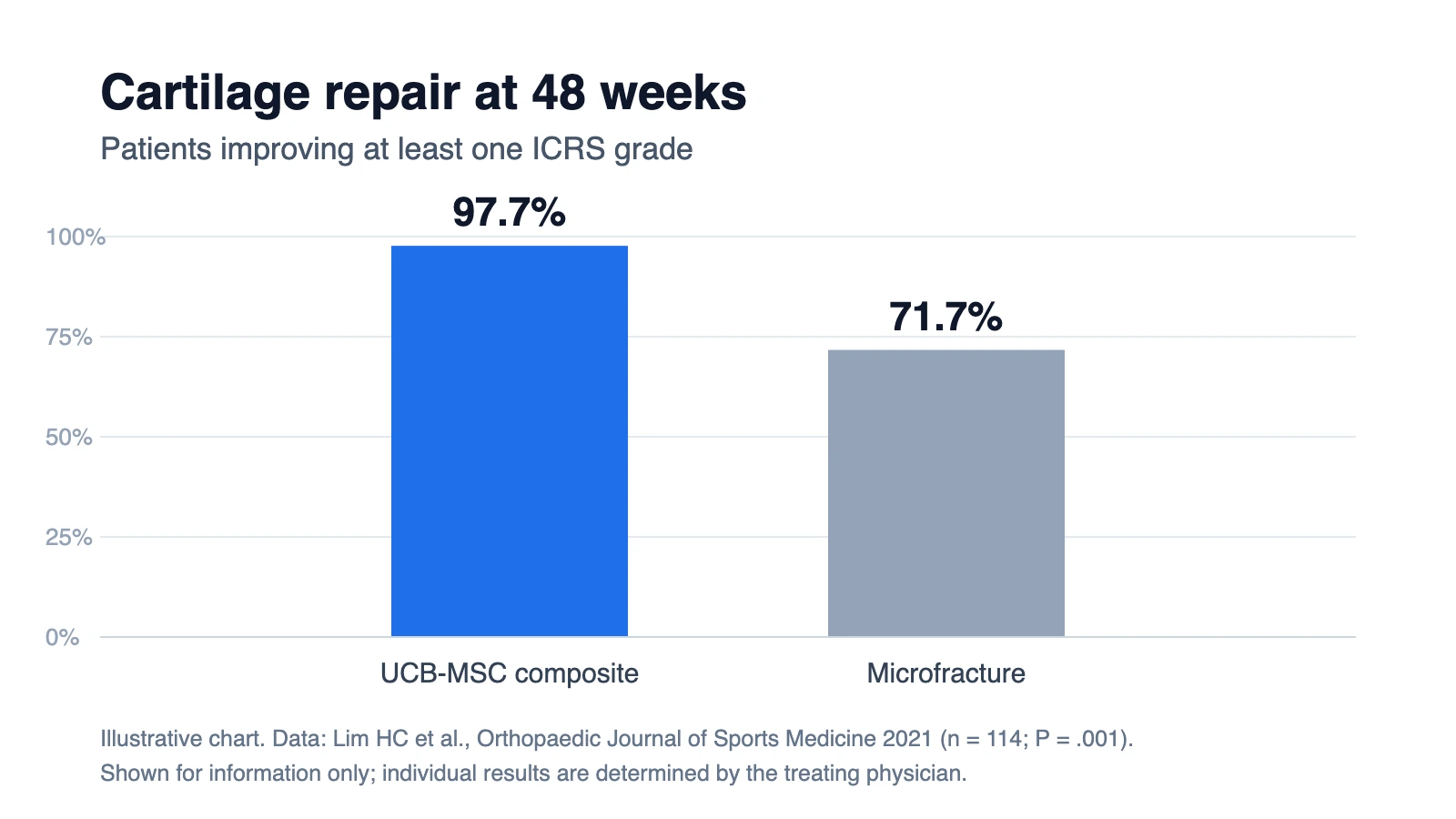
The most thoroughly published Korean stem cell application is an allogeneic UCB-MSC and hyaluronate composite used for full-thickness knee cartilage defects. In a multicentre randomised trial of 114 patients (mean age 55.9 years) comparing this composite with microfracture, 97.7% of the UCB-MSC group showed at least a one-grade ICRS improvement at 48 weeks versus 71.7% after microfracture (P = .001). Pain and function scores improved significantly in both groups, with no difference between them at 48 weeks; in the extended follow-up, the microfracture group deteriorated after three years while the UCB-MSC group maintained its gains, with significant differences at 36 and 60 months [1].
An earlier proof-of-concept study followed seven patients with Kellgren-Lawrence grade 3 osteoarthritis for seven years. Visual analogue pain scores improved from 49.1 to 19.3 and IKDC scores from 39.1 to 63.2 at 24 weeks; histology at one year showed hyaline-like cartilage, and no serious adverse events, tumour formation or abnormal bone growth were reported over seven years [2].
These results support a specific use in selected patients with defined cartilage defects. They do not support stem cell injection as a general remedy for ageing joints, and they say nothing about other organs or diseases.
Who qualifies for stem cell therapy in Korea under the 2025 rules
An amendment promulgated on 20 February 2024 took effect on 21 February 2025. It removed the restriction that limited participation to clinical research subjects and, for the first time, permitted advanced regenerative medicine to be delivered as treatment — while limiting that treatment to people with serious life-threatening conditions, rare diseases, or other intractable diseases for which no alternative therapy exists. Institutions must monitor adverse reactions, and the Ministry of Health and Welfare may order a treatment to stop; treatment costs must be reported and disclosed [6][7].
In practice this means an international patient cannot simply request a stem cell procedure. Eligibility is decided by diagnosis and by whether a designated institution has an approved protocol covering that condition. A realistic first step is a document review that establishes which category, if any, a patient falls into.
How international patients apply
- Send your diagnosis, imaging and recent test results to MEDIWIN for an initial review.
- MEDIWIN forwards the case to the appropriate partner hospital department and requests a written medical opinion.
- The hospital confirms whether an approved product or a designated regenerative protocol applies to your condition — or recommends a conventional alternative.
- If a treatment plan is issued, MEDIWIN arranges appointment scheduling, the medical visa invitation, interpretation and airport transfer.
MEDIWIN is a Korean government-registered foreign patient attraction agency (registration A-2022-01-01-4465) working with three partner hospitals, and every case is reviewed by a physician before a plan is proposed. If no approved option exists for your condition, we will tell you that rather than propose one. You can also read our article on proton therapy in Korea, or request a second opinion first.
Frequently asked questions
Can I get stem cell therapy in Korea for any condition?
No. Treatment is limited to approved products for their licensed indications, or to advanced regenerative medicine at a designated institution for serious, rare or intractable disease with no alternative [6].
Is stem cell therapy in Korea covered by insurance?
Only a small number of products hold national reimbursement, and Korean national insurance does not cover visiting foreign patients. Costs are quoted by the treating hospital after review.
How long does the evaluation take?
A document review usually takes several working days once complete records are received; scheduling depends on the department.
Are stem cell procedures safe?
In the knee cartilage studies cited above, no serious adverse events, tumour formation or abnormal bone growth were observed over follow-up periods of five and seven years [1][2]. Safety findings apply only to the specific product, dose and indication studied.
References
- Lim HC, Park YB, Ha CW, Cole BJ, et al. Allogeneic Umbilical Cord Blood-Derived Mesenchymal Stem Cell Implantation Versus Microfracture for Large, Full-Thickness Cartilage Defects in Older Patients: A Multicenter Randomized Clinical Trial and Extended 5-Year Clinical Follow-up. Orthopaedic Journal of Sports Medicine. 2021;9(1). Link
- Park YB, Ha CW, Lee CH, Yoon YC, Park YG. Cartilage Regeneration in Osteoarthritic Patients by a Composite of Allogeneic Umbilical Cord Blood-Derived Mesenchymal Stem Cells and Hyaluronate Hydrogel: Results from a Clinical Trial for Safety and Proof-of-Concept with 7 Years of Extended Follow-Up. Stem Cells Translational Medicine. 2017;6(2):613-621. Link
- Kim DS, Bae S. Impact and challenges of enactment for advanced regenerative medicine in South Korea. Frontiers in Bioengineering and Biotechnology. 2022;10:972865. Link
- Kim DS, Lee G, Cho H, Bae S. Regenerative Medicine in South Korea: Bridging the Gap Between Authorization and Reimbursement. Frontiers in Bioengineering and Biotechnology. 2021;9:737504. Link
- Ministry of Food and Drug Safety. Enforcement Decree of the Advanced Regenerative Medicine and Advanced Biopharmaceuticals Safety and Support Act Passes Cabinet Meeting. 2020. mfds.go.kr
- Shin & Kim LLC. Amendment and enforcement of the Act on the Safety and Support of Advanced Regenerative Medicine and Advanced Biopharmaceuticals. 2024. shinkim.com
- Kim CH. Industry welcomes revision to Advanced Regenerative Biotech Act. Korea Biomedical Review. 2 February 2024. koreabiomed.com
Written by MEDIWIN Medical Editorial Team.
Medical review: Park JinHeung, MD, PhD — review scheduled after publication.
This article is general health information and is not a diagnosis, a treatment recommendation, or a guarantee of any medical outcome. Eligibility for any procedure is determined by the treating physician. MEDIWIN Co., Ltd. — foreign patient attraction agency registration A-2022-01-01-4465.