




MEDIWIN Articles · Cancer treatment · Updated 22 September 2026 · 7 min read
Proton therapy in Korea is available at a small number of hospitals, including Samsung Medical Center in Seoul, which has treated more than 8,000 patients since December 2015. Proton therapy is a form of radiotherapy that stops inside the tumour instead of passing through the body, so it can spare nearby healthy tissue. It is not better for every cancer: professional guidelines recommend it mainly for children, tumours near the brain, spine or base of the skull, some liver cancers and repeat irradiation.
Key points
- Protons deliver most of their energy at a set depth (the Bragg peak) and very little beyond it.
- The clearest evidence of benefit is in children and in tumours next to critical organs.
- For common cancers such as prostate or breast, the evidence is still being gathered in trials.
- Whether proton therapy suits you is decided by a radiation oncologist after reviewing your scans.
What is proton therapy and how is it different from X-ray radiotherapy?
Conventional radiotherapy uses photons (high-energy X-rays). A photon beam deposits dose all the way along its path, so tissue in front of and behind the tumour also receives radiation. Protons are charged particles. They release a small dose on entry, a sharp peak of energy at a depth set by the beam energy, and almost nothing after that point. Doctors spread this peak across the tumour so the whole target is covered.
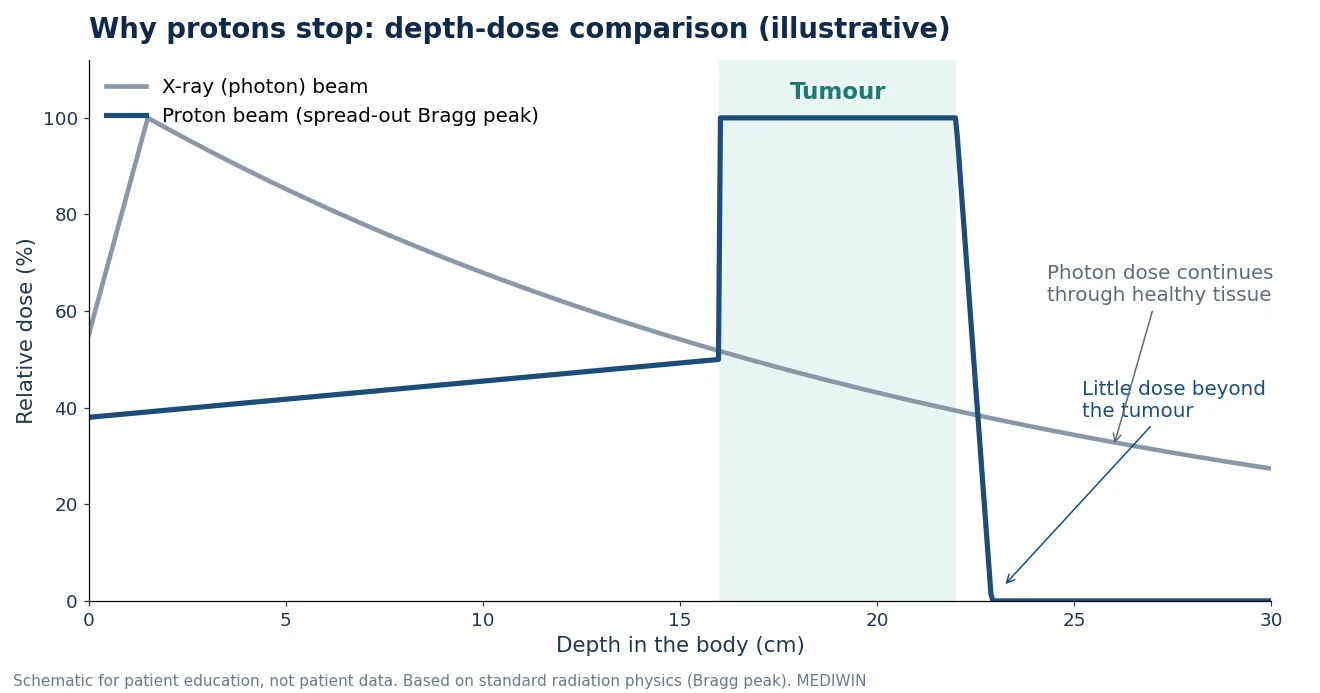
For proton therapy in Korea, as elsewhere, this physical difference matters most when a tumour sits close to structures that tolerate radiation poorly, such as the spinal cord, brainstem, optic nerves or a growing child’s organs. In a review of paediatric practice, Thomas and Timmermann reported that proton plans for ependymoma reduced dose to normal brain by 28–64% compared with photon plans, and that a medulloblastoma cohort treated with protons showed less decline in IQ over seven years of follow-up.[1]
Who is proton therapy in Korea recommended for?
The American Society for Radiation Oncology (ASTRO) model policy groups the conditions where proton therapy is considered medically necessary. Its Group 1 list includes:[2]
| Situation | Why protons are considered |
|---|---|
| Solid tumours in children treated with curative intent | Lower dose to growing tissue and fewer late effects |
| Primary brain and central nervous system tumours | Protects surrounding brain and nerves |
| Skull base tumours (chordoma, chondrosarcoma) | High doses are needed next to the brainstem |
| Tumours of the spine where cord tolerance is a concern | Keeps spinal cord dose within limits |
| Hepatocellular carcinoma (liver cancer) | Spares the remaining healthy liver |
| Eye tumours, advanced head and neck and sinus cancers | Many critical structures in a small area |
| Re-irradiation of a previously treated area | Limits cumulative dose to normal tissue |
For prostate, breast, lung and several other cancers, ASTRO places proton therapy in Group 2: it may be appropriate, but ideally within a clinical trial or registry, because comparative evidence is still maturing.[2] In other words, proton therapy in Korea is a precise tool for specific situations, not an upgrade that every patient needs.
Where is proton therapy in Korea available?
Korea’s first proton facility opened at the National Cancer Center in Goyang, which began treating patients in March 2007.[3] In Seoul, Samsung Medical Center treated its first proton patient in December 2015. Its centre, described in the Radiation Oncology Journal as the first private-hospital proton centre in Korea, uses a 230 MeV cyclotron and two treatment rooms, one of them with a dedicated pencil-beam scanning nozzle.[4] According to the hospital’s 10-year white paper, 8,183 patients had been treated by 2025, across more than 100,000 treatment sessions.[5]
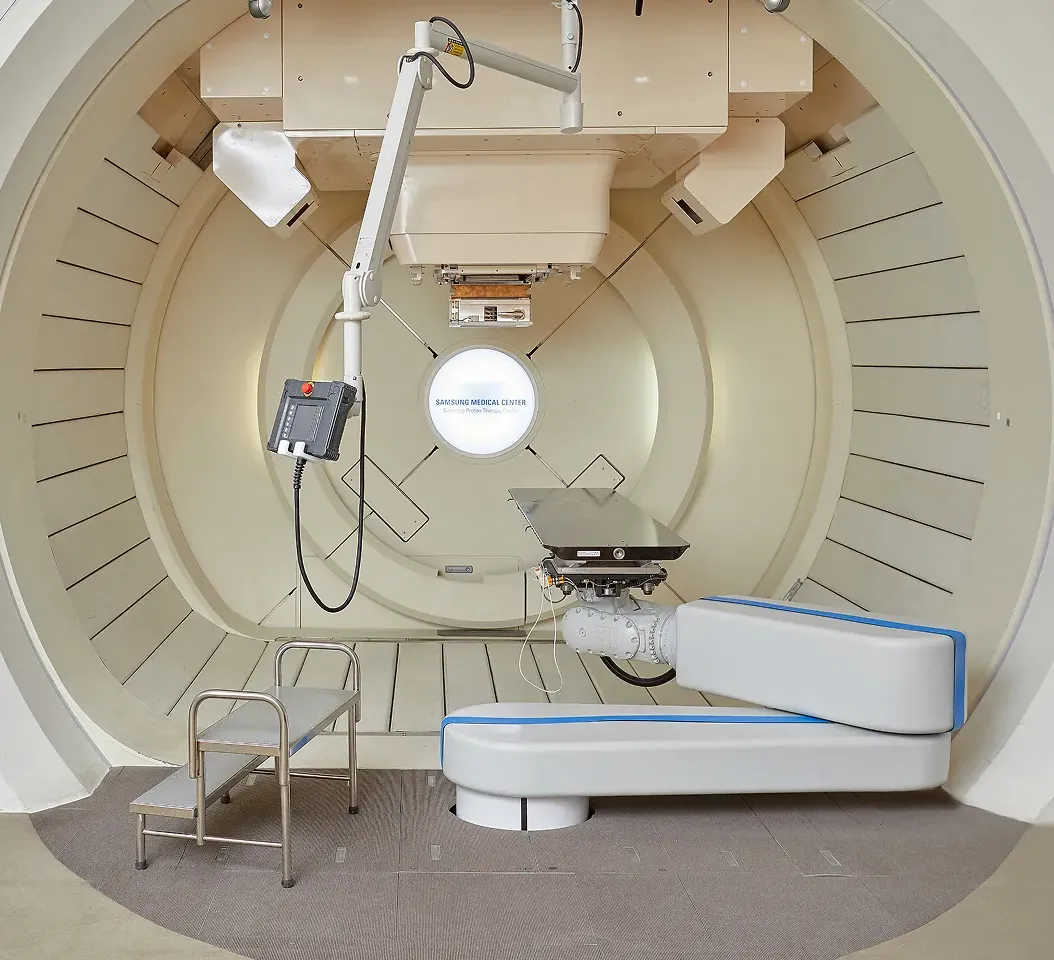
MEDIWIN holds a formal patient-referral agreement with Samsung Medical Center. You can read how international cases are handled on our Samsung Medical Center page, including how records are sent to the hospital.
How does an international patient apply for proton therapy in Korea?
- Send the diagnosis. Pathology report, recent CT, MRI or PET-CT reports, and a summary of treatment so far.
- Specialist review. The records are translated and reviewed by the hospital’s radiation oncology team, who decide whether protons, X-ray radiotherapy or another treatment fits the case.
- Written plan and estimate. If proton therapy is suitable, the hospital proposes the number of sessions and issues a written cost estimate before you travel.
- Treatment in Seoul. Proton therapy in Korea is usually given in daily outpatient sessions over several weeks, so plan accommodation near the hospital.
Starting with a second opinion from a Korean specialist is often the most useful first step, because it tells you whether proton therapy is worth pursuing before any travel is booked.
Frequently asked questions
Is proton therapy better than regular radiotherapy?
Not in every case. It reduces dose to healthy tissue, which is clearly valuable for children and tumours near critical organs. For many adult cancers, large trials have not yet shown better survival than modern X-ray techniques.[2]
How long does proton therapy take?
Each session usually lasts under an hour including positioning, with a few minutes of beam time. The total course depends on the diagnosis and is set by the treating radiation oncologist.
How much does proton therapy in Korea cost?
There is no fixed price. The hospital issues a written estimate after reviewing your records, based on the number of sessions and any additional care needed. See how treatment costs in Korea are estimated for details.
Is proton therapy in Korea an option for your case?
Send the diagnosis and scan reports. A MEDIWIN coordinator arranges a specialist review at a Seoul university hospital.
References
- Thomas H, Timmermann B. Paediatric proton therapy. Br J Radiol. 2020;93(1107):20190601. PMC7066960
- American Society for Radiation Oncology. Model Policies: Proton Beam Therapy (PBT). 2017. Summary: ASCO Post
- Kim J. Status of the proton therapy facility at the National Cancer Center, Korea. J Korean Phys Soc. 2008;52:738. JKPS
- Chung K, Han Y, Kim J, et al. The first private-hospital based proton therapy center in Korea; status of the Proton Therapy Center at Samsung Medical Center. Radiat Oncol J. 2015;33(4):337–343. ROJ
- Samsung Medical Center publishes white paper to mark 10th anniversary of Proton Therapy Center. The Asia Business Daily, 28 April 2026. Link
Written by MEDIWIN Medical Editorial Team, based on the published medical references listed above.
Medical review Park Jin Heung, MD — review scheduled after publication.
This article is general information and not medical advice. Treatment decisions are made by the treating hospital’s physicians. MEDIWIN Co., Ltd. is a foreign-patient facilitator registered in Korea (No. A-2022-01-01-4465).