




MEDIWIN Articles · Plastic surgery · Updated 5 October 2026 · 7 min read
Breast implant revision in Korea is a second operation, and second operations start from a different question. Not which implant to choose, but what has changed with the one already in place, what the imaging and the original record show, and what the treating surgeon finds on examination. The US Food and Drug Administration states that breast implants “are not considered lifetime devices” and that “the longer people have them, the greater the chances are that they will develop complications.”[1] This article summarises what published sources say, so that readers can ask better questions of a doctor. It is not medical advice and does not recommend any procedure.
Five things to prepare before any consultation abroad
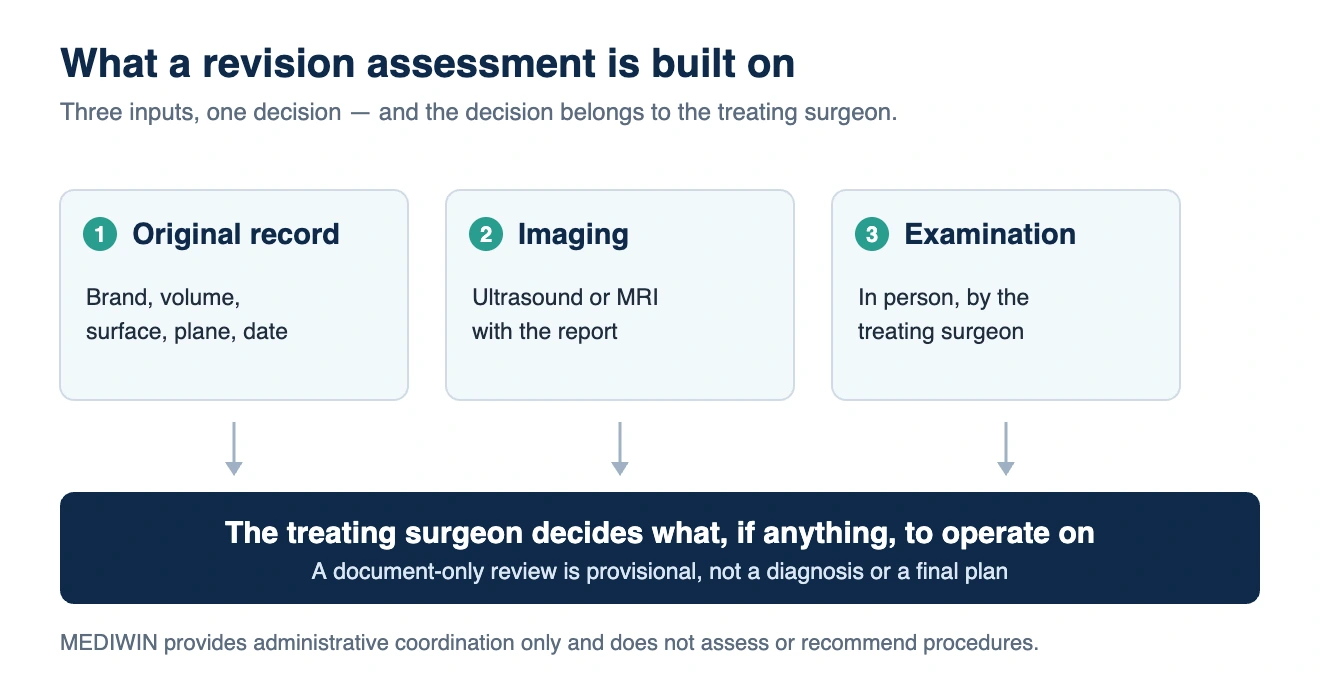
- Your original operative record or implant card — brand, volume, surface, and the plane the implant was placed in. If it is available, assessment and planning can be more precise.
- Imaging, as advised by a doctor. For silent rupture of silicone gel-filled implants specifically, the FDA describes MRI as the most effective detection method and ultrasound as an acceptable screening alternative for patients without symptoms.[1]
- A written note of what has changed — firmness, shape, size, asymmetry, pain or swelling — and when it started.
- How long you could stay for the follow-up schedule the treating surgeon sets, and who would see you after you return home.
- Confirmation that you will be told the name of the medical institution and given written estimated fees before you commit to anything.
What MEDIWIN can and cannot do for an international patient
MEDIWIN Co., Ltd. is a foreign-patient facilitator registered in Korea (Registration No. A-2022-01-01-4465). MEDIWIN provides administrative coordination only: at the patient’s request it can transmit submitted records to an independently operated registered medical institution, and arrange scheduling, interpretation, the visa letter and travel-related support. MEDIWIN does not recommend a procedure, determine whether an operation is suitable, diagnose a condition or provide treatment.
Any medical opinion is issued by that institution’s physician, not by MEDIWIN. A document-based opinion is provisional; it is not a diagnosis or a final treatment plan, which are determined by the treating physician after assessment in person. Coordination is available to people aged 18 or over living outside Korea.
Please send written information only at first contact — MEDIWIN does not accept body photographs. Images, ultrasound and MRI go directly to the medical institution’s own channel. You pay the institution directly; there is no separate coordination fee from MEDIWIN. Coordinators answer from Seoul by WhatsApp or Telegram (+82 10 8864 3792) and by email (mediwinkorea@gmail.com).
Why implants are revised
Klinger and colleagues note that breast augmentation ranked first among the five leading cosmetic surgical procedures worldwide in 2019, and describe it as the aesthetic procedure with a high reoperation rate.[6] The reasons people return cluster into a short list: the capsule around the implant tightens and the breast becomes firm or distorted; the implant ruptures or deflates; the shape changes as tissue ages or weight shifts; the patient wants a different size; or the patient wants the implants removed altogether.
Depending on severity and clinical findings, revision for capsular contracture may involve implant removal or replacement and may involve partial or complete capsule surgery. Management of a ruptured implant likewise depends on the individual findings and the patient’s goals. A size change may be straightforward or may require the breast to be lifted at the same time. This is why planning rests on the old record, current imaging and an examination rather than on a photograph.
What the evidence says about capsular contracture
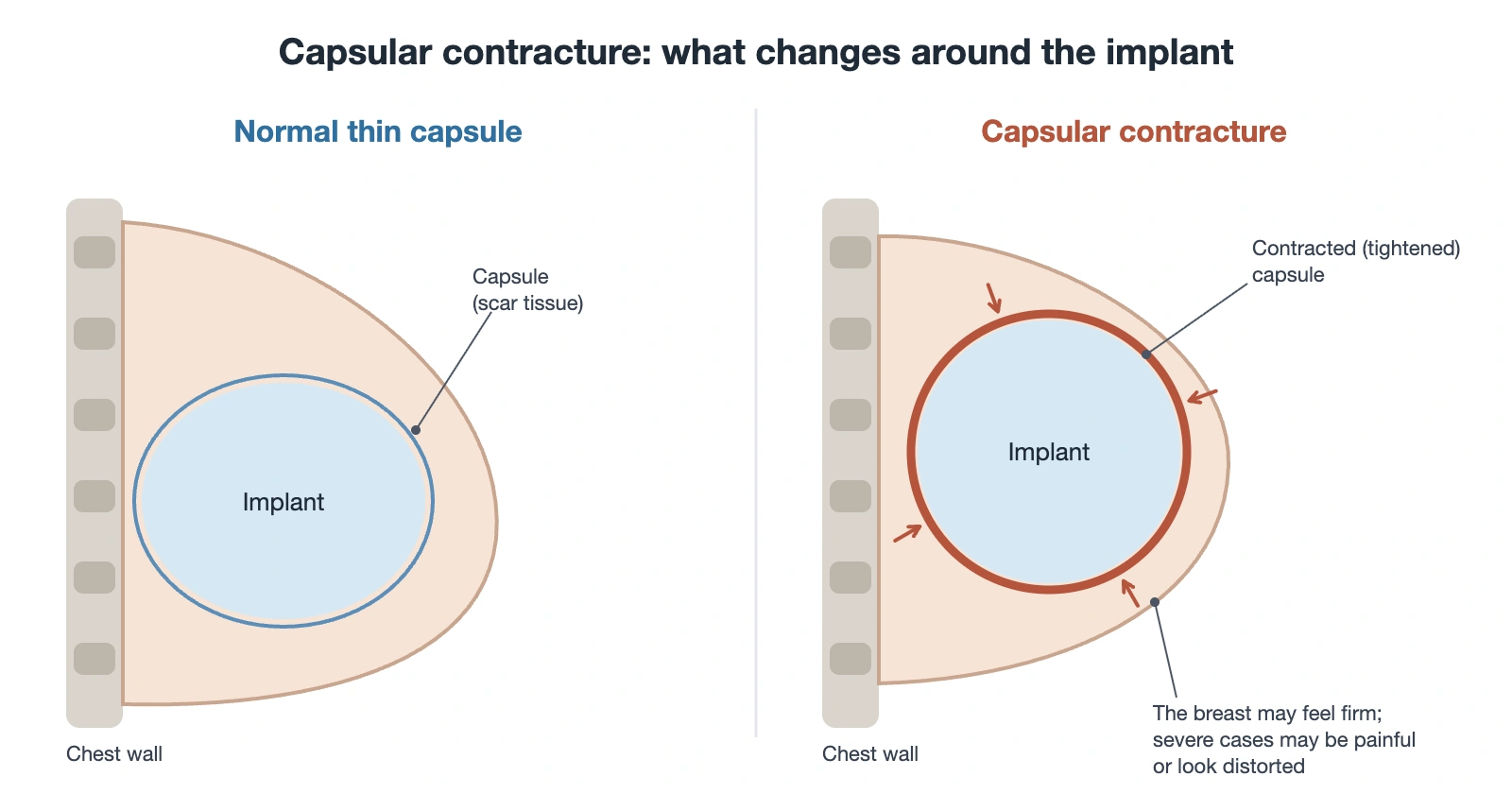
Capsular contracture is the hardening of scar tissue around an implant. The FDA describes four Baker grades and notes that grades III and IV are considered severe and may require reoperation.[1] A 2025 systematic review and meta-analysis of 24 studies examined what shifts the odds.[2]
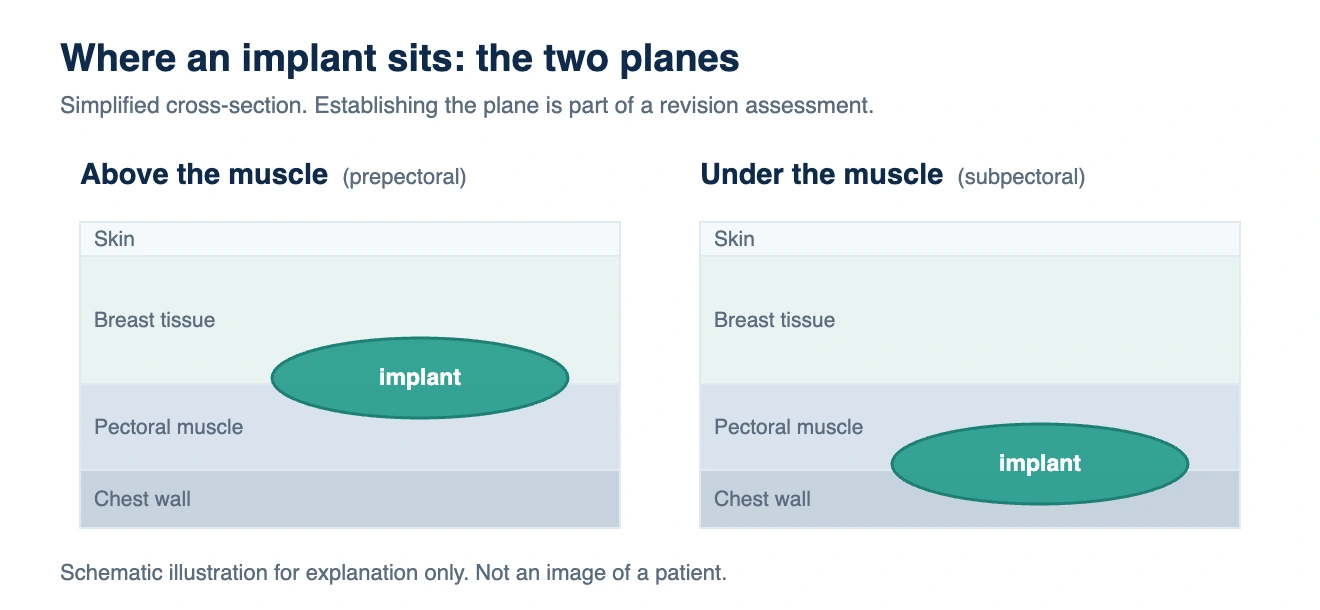
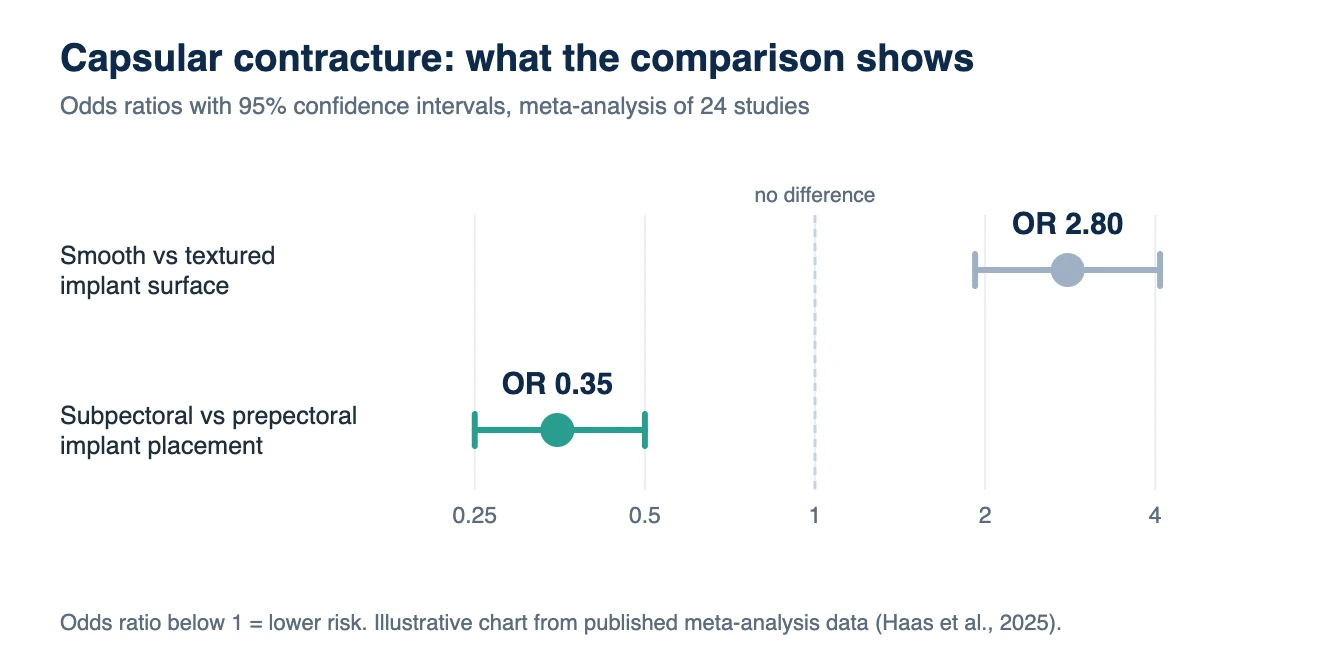
Placement under the pectoral muscle was associated with lower odds of contracture than placement above it (OR 0.35, 95% CI 0.25–0.50), and smooth implants showed higher odds than textured ones (OR 2.80, 95% CI 1.92–4.08).[2] The authors are explicit about the limits: most included studies were non-randomised, with a low level of evidence and a significant degree of heterogeneity, and some had follow-up of only 12 months or did not state it. These are pooled associations, not predictions for an individual.
The lower contracture odds associated with textured implants in that meta-analysis must also be read separately from the established concern about BIA-ALCL and textured-device exposure, described below. Implant selection is an individual risk–benefit discussion with the treating surgeon, not a choice that can be settled from two endpoints in advance.
Rupture, implant-associated malignancies and systemic symptoms
| Concern | What the cited sources report |
|---|---|
| Silent rupture | A silicone gel-filled implant can rupture without symptoms. The FDA describes MRI as the most effective detection method, with ultrasound an acceptable screening alternative for patients without symptoms.[1] |
| BIA-ALCL | A T-cell lymphoma associated with breast implants; it is not breast cancer. A meta-analysis of 17 epidemiological studies covering 525,475 implant patients identified 254 cases, diagnosed on average 13.2 years after implantation.[3] In a 2021 review, two US studies in reconstructive patients reported patient-specific cumulative risks of about 1 in 559 and 1 in 355 among patients exposed to textured implants; estimates varied substantially by implant type and study, and that review reported no case with a confirmed history exclusively of smooth-device exposure.[4] |
| Other malignancies | The FDA reports that scientific literature and Medical Device Reports include squamous cell carcinoma and lymphomas other than BIA-ALCL in the scar tissue around implants, and that it has become aware of reports of mesenchymal tumours, including sarcomas of the breast, in patients with breast implants.[1] These reports do not establish an incidence estimate. Persistent swelling, a mass or another unexplained change warrants medical assessment. |
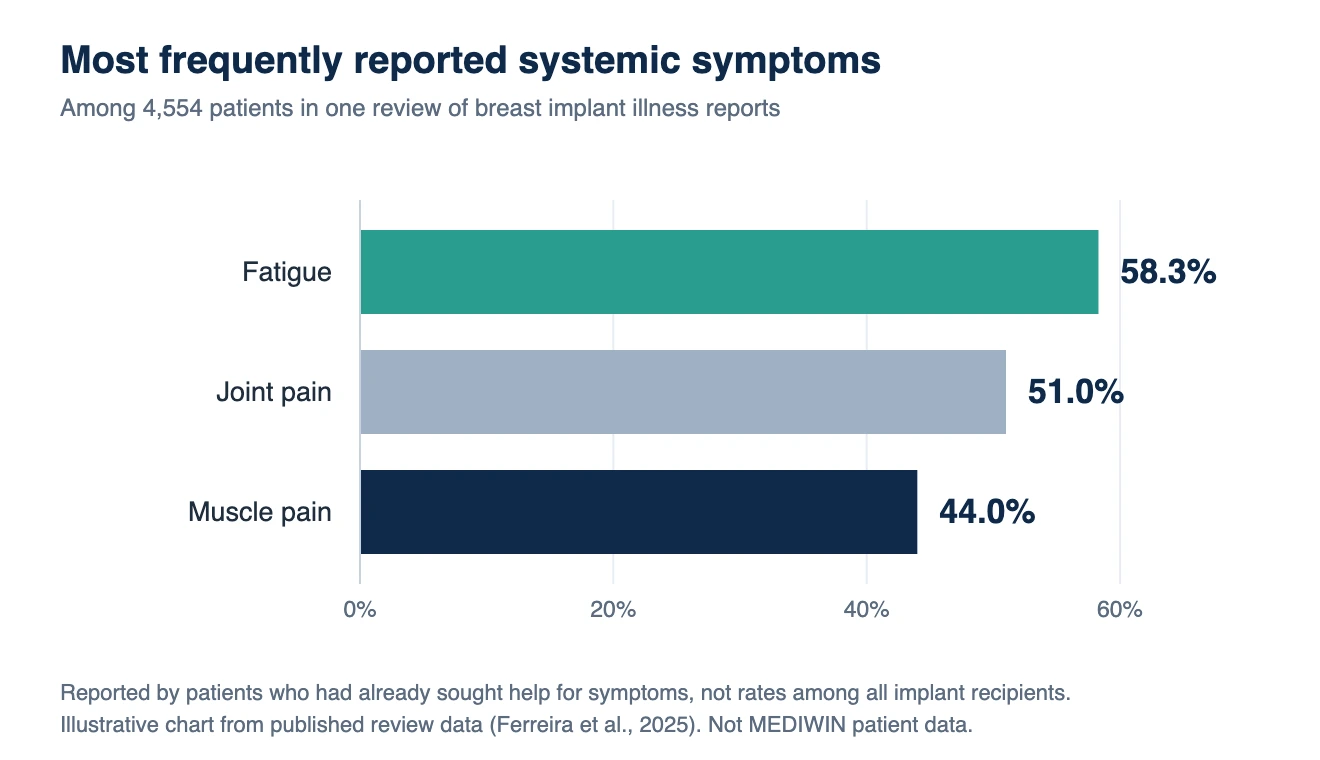
| Systemic symptoms | A review of 33 studies included 6,048 women overall. Symptom frequencies were drawn from 4,554 patients: fatigue 58.3%, joint pain 51%, muscle pain 44%. Post-explantation outcomes were available for 1,073 patients, of whom 879 (81.9%) reported symptom improvement.[5] That figure describes those 1,073 patients, not all implant recipients. The authors describe the mechanisms as unsettled. |
| Rupture and contracture in those reports | Within the same review, implant rupture or gel bleed was reported in 481 of 2,251 patients (21.4%) and capsular contracture in 1,136 of 2,560 patients (44.4%).[5] The denominators differ and describe selected symptomatic groups, not everyone with implants. |
Some implant-related problems present years after implantation, while others can occur earlier; the FDA lists complications that can appear shortly after surgery as well as late ones.[1] That is the practical reason to keep the original operative record and to have any new change looked at rather than waiting.
What revision surgery can and cannot do
Revision addresses a defined problem: capsule surgery, replacing or removing an implant, changing size or plane, correcting asymmetry or malposition, or removal with or without a lift. A 2025 retrospective observational study of 306 women described six surgical approaches that the authors combined according to the reason for reoperation.[6] It is a single-centre series at a low level of evidence, not a guideline.
What revision cannot do is guarantee an outcome. It is another surgical procedure and therefore carries surgical and anaesthesia risks; previous operations may also affect scar tissue and local anatomy. The specific risks depend on the proposed procedure and must be discussed with the treating surgeon. After implant removal without replacement, the FDA notes that changes such as dimpling, chest wall concavity, puckering or sagging of the natural breast can occur.[1] No surgeon can promise a result in advance, and any article, advertisement or coordinator that does is one to walk away from.
Preparing the paperwork before an overseas consultation
- Gather the record. The operative note or implant card from the first surgery — brand, volume, surface, plane, date — plus any later procedures.
- Arrange imaging as a doctor advises. Bring the radiology report as well as the images. Reports in English help; translation can be arranged.
- Write down the problem. What changed, when it began, and any pain, firmness, swelling or shape change. No photographs at this stage.
- Provisional opinion and estimated fees. A medical institution may give a provisional document-based opinion and estimated fees. Neither is a diagnosis nor a final treatment plan; those are determined by the treating physician after assessment in person.
Administrative details of how records are transmitted and appointments arranged are on our breast surgery and revision page. If you are not yet sure whether surgery is the right step, a pre-travel case review may be the more useful starting point, and our note on how treatment costs in Korea are estimated explains why no fixed price can be published.
Frequently asked questions
Do implants have to be replaced, or can they simply be removed?
Removal without replacement is a recognised option; in the review cited above, post-explantation outcomes were reported for 1,073 patients.[5] The FDA notes that appearance changes such as dimpling, concavity, puckering or sagging can follow removal.[1] What removal alone would mean in a particular case is for the treating surgeon to explain.
Is revision possible without the original operative record?
Often yes, though assessment is less precise. Imaging can show the plane and whether an implant has ruptured, but it cannot reliably identify the brand or exact volume. It is worth asking the original clinic for the record.
How long is a stay in Korea likely to be?
There is no single answer; it depends on the procedure and whether drains or staged operations are involved. The treating surgeon sets the follow-up schedule, and travel arrangements are planned around what the medical institution confirms.
Administrative help contacting a Korean medical institution
If you are a foreign patient aged 18 or over living outside Korea, MEDIWIN can assist with record transfer, appointment coordination, interpretation and travel logistics. Send written information only — no photographs. Medical assessment and treatment decisions are made solely by the treating medical institution.
References
- US Food and Drug Administration. Risks and Complications of Breast Implants. Updated 15 December 2023. fda.gov
- Haas E, Christodoulou N, Secanho M, et al. Capsular contracture after breast augmentation: a systematic review and meta-analysis. Aesthet Surg J Open Forum. 2025;7. doi:10.1093/asjof/ojaf003
- Elameen AM, AlMarakby MA, Atta TI, Dahy AA. The risk of breast implant-associated anaplastic large cell lymphoma: a systematic review and meta-analysis. Aesthetic Plast Surg. 2024;48. doi:10.1007/s00266-024-03956-9
- Lynch EB, DeCoster RC, Vyas KS, et al. Current risk of breast implant-associated anaplastic large cell lymphoma: a systematic review of epidemiological studies. Ann Breast Surg. 2021;5. doi:10.21037/abs-20-96
- Ferreira S, Barros AS, Marques M. Breast implant illness: symptoms, outcomes with explantation and potential etiologies — a systematic review and meta-analysis. Aesthetic Plast Surg. 2025;49. doi:10.1007/s00266-025-05142-x
- Klinger M, Berrino P, Bandi V, et al. Secondary breast augmentation: the six winning moves. Aesthetic Plast Surg. 2025;49. doi:10.1007/s00266-024-04315-4
Written by MEDIWIN Editorial Team, summarising the published sources listed above. This article has not been reviewed by a plastic surgeon, and nothing in it should be read as a clinical opinion.
This article is general information and not medical advice. MEDIWIN Co., Ltd. is a foreign-patient facilitator registered in Korea (No. A-2022-01-01-4465) and is not a medical institution; diagnoses and treatment decisions are made by the treating medical institution’s physicians.