




MEDIWIN Articles · Fertility · Updated 30 September 2026 · 9 min read
IVF in Korea is provided by specialist fertility centres that also publish their own clinical research. Doctors and embryologists at CHA fertility centres in Seoul and Bundang have reported in peer-reviewed journals how they test ovarian reserve, treat women who produce few eggs, choose embryos and prepare the womb for a frozen transfer. This article explains eight of those studies in plain language, so you can prepare better questions for your own doctor.
Key points
- In women aged 40 or older starting IVF, antral follicle count and AMH both helped predict pregnancy; antral follicle count predicted live birth best.[4]
- For women whose ovaries respond poorly, estrogen priming and sustained-release growth hormone increased the number or maturity of eggs, but neither study proved a higher pregnancy rate.[5][6]
- Well-graded blastocysts were more often chromosomally normal, but grading alone cannot replace genetic testing when it is medically indicated.[3]
- Children born after in vitro maturation (IVM) to mothers with PCOS showed no higher health risk than IVF children over 7.5 years.[1]
Where do these IVF studies come from?
All eight studies were written by teams at CHA University School of Medicine: the Fertility Center of CHA Gangnam Medical Center, CHA Fertility Center Seoul Station and the Fertility Center of CHA Bundang Medical Center. Each was published in an indexed international journal. MEDIWIN coordinates care for international couples at CHA Fertility Center Magok, a CHA fertility centre in western Seoul; you can read more about the hospital group on our CHA Hospital profile.
| Topic | Journal | Main finding |
|---|---|---|
| Ovarian reserve after 40 | Eur J Obstet Gynecol Reprod Biol, 2018 | Antral follicle count was the best single predictor of live birth; AMH also helped[4] |
| Poor responders: estrogen priming | J Assist Reprod Genet, 2012 | Fewer cancelled cycles and more eggs retrieved[5] |
| Poor responders: growth hormone | Arch Gynecol Obstet, 2018 | More mature eggs, but no proven rise in pregnancy[6] |
| Embryo grade and chromosomes | J Korean Med Sci, 2019 | Top-graded blastocysts were more often euploid[3] |
| Frozen blastocyst selection | Reprod Sci, 2021; J Clin Med, 2022 | Expansion, inner cell mass and day 5 growth mattered[7][8] |
| Thin endometrium and PRP | Front Endocrinol, 2019 | Small pilot study; no proven thickness gain[2] |
| Children born after IVM | Fertil Steril, 2019 | No higher health risk at a mean age of 7.5 years[1] |
These are single-centre studies. They describe groups of patients, not your own chance of pregnancy, and several were retrospective. Read them as a guide to how CHA doctors think about each step of IVF in Korea, not as a promise of results.
1. Testing ovarian reserve after age 40
Before IVF, doctors estimate how many eggs the ovaries can still produce. The two common tests are the blood level of anti-Müllerian hormone (AMH) and an ultrasound count of small antral follicles (AFC). A CHA Gangnam team analysed 219 women aged 40 or older in their first IVF cycle. In this age group, 16.4% had a clinical pregnancy and 12.3% gave birth. Antral follicle count was the most accurate single predictor of live birth, followed by age and the number of eggs retrieved; AMH was linked with clinical pregnancy.[4]
For couples planning IVF in Korea, the practical lesson is simple: bring a recent AMH result and, if possible, an ultrasound report with the antral follicle count. Doctors use both, together with age, to plan the dose of stimulation.
2. When the ovaries respond poorly
Some women produce very few eggs even with high doses of medication, and poor response is a common reason couples look for IVF in Korea after treatment at home. CHA doctors have tested two approaches for these “poor responders”. In a study of 155 women with previous poor response, taking oral estradiol from the luteal phase of the previous cycle (estrogen priming) was associated with fewer cancelled cycles (15.1% vs 37.7%) and more eggs retrieved (4.5 vs 3.2) than a standard antagonist protocol.[5]
In a randomised controlled trial at CHA Fertility Center Seoul Station, 127 poor responders (mean age 39.6 years, mean AMH 0.6 ng/mL) received either a sustained-release growth hormone before and during stimulation or no growth hormone. The growth hormone group had more follicles on trigger day and a higher proportion of mature (metaphase II) eggs, 67.5% vs 52.3%. Clinical and ongoing pregnancy rates, however, were not different between the groups.[6]
These results show why a protocol for poor response is individual. More or better eggs do not automatically mean a higher chance of birth, and your doctor should explain what a change of protocol can and cannot do.
3. Choosing embryos: grading and genetic testing
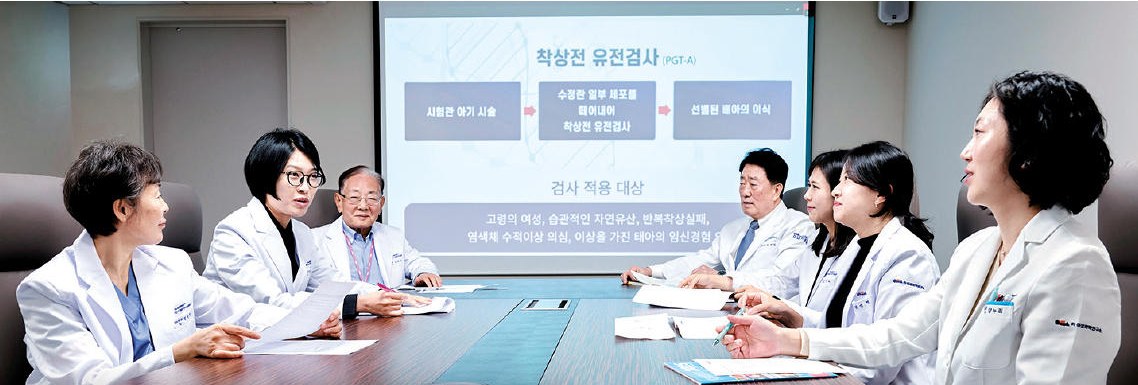
Embryologists grade blastocysts by their appearance under the microscope. In a CHA study of IVF cycles with preimplantation genetic screening, blastocysts graded “excellent” were chromosomally normal (euploid) in 47.8% of cases, compared with about 29% in the “fair” and “poor” groups. After transfer of screened embryos, clinical pregnancy rates in women under and over 35 were similar (44.7% vs 47.8%).[3]
Grading and genetic testing therefore give different information. For IVF in Korea, genetic testing of embryos is regulated and offered only when the doctor finds a medical reason, such as recurrent miscarriage, repeated implantation failure or a known genetic condition in the family.
4. Frozen blastocyst transfer: what predicts a good embryo
Many cycles of IVF in Korea now freeze blastocysts by vitrification and transfer one of them in a later cycle. In 329 single vitrified-warmed blastocyst transfers at CHA Gangnam, three features predicted ongoing pregnancy: a well-expanded blastocyst before freezing, a good inner cell mass grade after warming, and development to the blastocyst stage on day 5 rather than day 6.[7]
A later CHA study of 658 single frozen blastocyst transfers used time-lapse imaging to measure the diameter of each blastocyst before freezing and how quickly it re-expanded after warming. Both measurements added useful information to the usual quality score, alongside the woman’s age and the day the embryo was frozen.[8]

5. Thin endometrium: an early study of PRP
A thin lining of the womb that does not respond to standard treatment can contribute to repeated implantation failure. A CHA Bundang team ran a small pilot study of 24 women with two or more failed IVF cycles and an endometrium thinner than 7 mm. They received two or three infusions of their own platelet-rich plasma (PRP) into the uterus before a frozen embryo transfer. The average thickness rose by only 0.6 mm, which was not statistically significant, and 20% of the women had an ongoing pregnancy.[2]
Because this was a small study without a control group, PRP for thin endometrium should be regarded as an option still under study. Ask your doctor whether it is suitable for you and what evidence supports it before you plan IVF in Korea around it.
6. Long-term health of children born after IVM
In vitro maturation (IVM) collects immature eggs and matures them in the laboratory. It can suit some women with polycystic ovary syndrome (PCOS) because it uses little or no stimulation. CHA doctors compared 184 women who conceived with IVM and 366 who conceived with conventional IVF, all with PCOS. The children were followed to a mean age of 7.5 years. Congenital anomalies (4.3% vs 4.1%), birth weight, childhood hospital stays and growth were similar in both groups.[1] IVM is offered at some centres that provide IVF in Korea; the doctor decides whether it suits you.
What this means if you are planning IVF in Korea
- Bring complete records. AMH, an antral follicle count, a semen analysis and reports of earlier cycles, including the number of eggs, fertilisation and embryo grades.
- Ask about your protocol. If you have responded poorly before, ask which protocol the doctor proposes and why.
- Ask how embryos are chosen. Ask whether embryos will be frozen, how they are graded and whether genetic testing is medically indicated in your case.
- Know the legal limits. Korean law prohibits choosing the baby’s sex and buying or selling eggs or sperm, and surrogacy is not offered. Clinics may require proof of marriage depending on the treatment.
How international couples apply
- Send your results. Both partners’ recent tests and reports of previous IVF cycles.
- Specialist review. The CHA fertility team reviews them and proposes a plan.
- Written estimate. The hospital issues a written cost estimate before you travel; you pay the hospital directly.
- Treatment in Seoul. One IVF cycle usually takes about two to three weeks; some couples freeze embryos and return later for the transfer.
Read more about the process on our infertility and IVF treatment in Korea page. If you have had several failed cycles, a second opinion on your previous reports is a useful first step.
Frequently asked questions
Do these studies show my chance of success with IVF in Korea?
No. Each study describes a specific group of patients at one centre. Your own chance depends on age, ovarian reserve, sperm quality, the cause of infertility and other factors that only your doctor can assess.
Is genetic testing of embryos available with IVF in Korea?
Yes, but it is regulated. The doctor decides whether there is a medical reason for testing, such as recurrent miscarriage or a known genetic disease. It is not used to choose the baby’s sex.
How long do we need to stay in Korea for IVF?
One IVF cycle usually takes about two to three weeks in Seoul. If embryos are frozen, the transfer can be done on a second trip. The doctor confirms the schedule after reviewing your results.
Planning IVF in Korea?
Send your test results. A MEDIWIN coordinator arranges a review by the CHA fertility team and a written plan before you travel.
References
- Yu EJ, Yoon TK, Lee WS, Park EA, Heo JY, Ko YK, Kim J. Obstetrical, neonatal, and long-term outcomes of children conceived from in vitro matured oocytes. Fertil Steril. 2019;112(4):691–699. PubMed 31371040
- Kim H, Shin JE, Koo HS, Kwon H, Choi DH, Kim JH. Effect of autologous platelet-rich plasma treatment on refractory thin endometrium during the frozen embryo transfer cycle: a pilot study. Front Endocrinol (Lausanne). 2019;10:61. PubMed 30837945
- Kim MK, Park JK, Jeon Y, et al. Correlation between morphologic grading and euploidy rates of blastocysts, and clinical outcomes in in vitro fertilization preimplantation genetic screening. J Korean Med Sci. 2019;34(4):e27. PubMed 30686949
- Lee Y, Kim TH, Park JK, et al. Predictive value of antral follicle count and serum anti-Müllerian hormone: which is better for live birth prediction in patients aged over 40 with their first IVF treatment? Eur J Obstet Gynecol Reprod Biol. 2018;221:151–155. PubMed 29306180
- Chang EM, Han JE, Won HJ, Kim YS, Yoon TK, Lee WS. Effect of estrogen priming through luteal phase and stimulation phase in poor responders in in-vitro fertilization. J Assist Reprod Genet. 2012;29(3):225–230. PubMed 22160464
- Choe SA, Kim MJ, Lee HJ, et al. Increased proportion of mature oocytes with sustained-release growth hormone treatment in poor responders: a prospective randomized controlled study. Arch Gynecol Obstet. 2018;297(3):791–796. PubMed 29264647
- Kim HJ, Park JK, Eum JH, Song H, Lee WS, Lyu SW. Embryo selection based on morphological parameters in a single vitrified-warmed blastocyst transfer cycle. Reprod Sci. 2021;28(4):1060–1068. PubMed 33051819
- Park JK, Ahn SY, Seok SH, et al. Clinical usability of embryo development using a combined qualitative and quantitative approach in a single vitrified-warmed blastocyst transfer. J Clin Med. 2022;11(23):7085. PubMed 36498659
Written by MEDIWIN Medical Editorial Team, based on the published medical references listed above.
Medical review: Park JinHeung, MD, PhD — review scheduled after publication.
This article is general information and not medical advice. Treatment decisions are made by the treating doctor. It does not describe results for any individual patient. MEDIWIN Co., Ltd. is a foreign-patient facilitator registered in Korea (No. A-2022-01-01-4465).