


Last updated: 19 October 2026 · Written by MEDIWIN Editorial Team · How we selected sources: international clinical practice guidelines first, then Korean registry data, a systematic review, a cohort study and the Korean legal text; each reference was checked against its bibliographic record and, where the abstract or full text was openly available, against the publication itself.
For a patient travelling from abroad, a kidney transplant in Korea for foreign patients realistically means a living-donor transplant. Deceased-donor kidneys are allocated through Korea’s national waiting list, so it should not be planned around one, and MEDIWIN coordinates only cases in which the donor is a documented family member. Before anything is arranged, the transplant team has to answer three separate questions: is the recipient fit for transplant, is the donor healthy enough to give a kidney safely, and are the two compatible [1][2]. For a patient living abroad, sending the records of both people for a document-based review is normally the first step rather than travel. Anyone with severe breathlessness, chest pain, new confusion or a sudden marked fall in urine output should seek urgent medical assessment locally.
Key points
- Korean law prohibits buying or selling organs, requires the living donor’s own written consent, which can be withdrawn at any time before surgery, and allows only one of two healthy kidneys to be removed [6].
- Each Korean transplant centre applies its own eligibility, documentation and regulatory review for overseas patients; MEDIWIN coordinates living-donor kidney cases only when the donor is a documented family member.
- International guidance recommends assessing a recipient’s heart, cancer and infection risk, immune sensitisation and ability to take lifelong medicines, and referral at least 6 to 12 months before dialysis is expected to start [1].
- A different blood group does not automatically rule out a family donor: ABO-incompatible transplants made up 17.4% of all 6,129 kidney transplants in a Korean nationwide registry from 2014 to 2019, although they carry more rejection, infection and bleeding risk than compatible transplants [3][4].
- Donating a kidney carries a small but real long-term risk to the donor, which is why the donor is evaluated as carefully as the recipient [2][5].

Who MEDIWIN is, and what it does not do
MEDIWIN Co., Ltd. is a foreign-patient facilitator registered in Korea (Registration No. A-2022-01-01-4465) and is not a medical institution. MEDIWIN provides administrative coordination only: at the patient’s request it can transmit submitted records to an independently operated registered medical institution, and arrange scheduling, interpretation, the visa letter and travel-related support. MEDIWIN does not recommend a procedure, determine whether an operation or a transplant is suitable, diagnose a condition or provide treatment.
Any medical opinion is issued by that institution’s physician, not by MEDIWIN. A document-based opinion is provisional; it is not a diagnosis or a final treatment plan, which are determined by the treating physician after assessment in person. MEDIWIN does not find, recruit or screen living organ donors; donor eligibility is decided by the hospital and governed by the laws of both countries. Coordination is available to people aged 18 or over living outside Korea.
What Korean law allows for a living kidney donor

Korea’s Act on Organ Transplantation sets the framework for every living donation, whatever the nationality of donor and recipient. Organs may not be bought, sold or exchanged for any financial benefit, and arranging such a transaction is also prohibited. A living donor must give consent in a signed document and may withdraw it at any point before the operation begins. Only one of two normally functioning kidneys may be removed. People under 16 cannot donate a kidney, and a donor who is a minor aged 16 or older may donate only to a spouse, a parent, child or other lineal relative, a sibling, or a relative within the fourth degree of kinship, with the consent of a parent as well. A living donor may choose the recipient; when the recipient is outside the family relationships defined in the Act, prior approval from the national organ transplant agency (KONOS) is required [6].
Each transplant centre then applies its own eligibility, documentation and regulatory review for patients from abroad. Proof of a family relationship usually means official documents with certified Korean translation and legalisation, and the hospital explains what it requires. These safeguards reflect the international principles of the Declaration of Istanbul, which condemns organ trafficking and transplant tourism [7]. MEDIWIN coordinates living-donor kidney cases only when the donor is a documented family member and does not coordinate cases with an unrelated donor.
Who may be a candidate for a kidney transplant
The 2020 KDIGO guideline on transplant candidates recommends that people with chronic kidney disease stage G4 to G5 (an estimated glomerular filtration rate, eGFR, below 30 ml/min/1.73 m²) who are expected to progress to kidney failure be informed about and considered for transplantation, and referred for evaluation at least 6 to 12 months before dialysis is expected to start. It identifies a living-donor transplant before dialysis (a pre-emptive transplant) as the preferred option for suitable candidates [1]. Starting dialysis does not rule a patient out; many recipients have been on dialysis for years. What matters is the overall assessment, in which each health factor is considered separately and then together [1].
| What is assessed | Why it matters | What the team usually checks |
|---|---|---|
| Kidney function and timing | Evaluation takes time, so it should start at least 6 to 12 months before dialysis is expected in people whose kidney disease is progressing [1] | Recent eGFR trend, dialysis start date and type, cause of kidney failure [1] |
| Heart and blood vessels | Kidney failure raises cardiovascular risk, and surgery adds strain [1] | ECG, echocardiography and, depending on risk, stress testing or coronary imaging; arteries in the pelvis [1] |
| Cancer | Immunosuppression can make an existing cancer grow faster [1] | Age-appropriate screening and the history and treatment of any previous cancer [1] |
| Infection | Hidden infections can flare after transplant [1] | Hepatitis B and C, HIV, tuberculosis and other screening tests [1] |
| Immune sensitisation | Previous transplants, blood transfusions or pregnancies can create antibodies against donor tissue [1] | Anti-HLA antibody testing and crossmatch with the donor [1] |
| Daily life after transplant | The new kidney depends on taking anti-rejection medicines every day for life [1] | Adherence, support at home and whether the medicines and follow-up tests are available in the home country [1] |
Conditions such as an active cancer, an untreated infection or severe heart disease that cannot be treated may mean transplant has to wait or is not advisable. The guideline leaves the final judgement to the transplant team, taking all findings into account [1].
How the donor is evaluated
The 2017 KDIGO guideline on living kidney donors recommends judging the donor’s overall long-term risk rather than any single test in isolation [2]. The evaluation usually covers kidney function and urine tests, blood pressure, blood sugar, body weight, kidney stones, infections, cancer screening, family history and possible inherited kidney disease, imaging of both kidneys and their blood vessels, and a psychosocial assessment confirming that the decision is voluntary and informed [2]. A donor can be declined for their own safety even if they are willing.
The long-term risk to a carefully screened donor is small but not zero. In a United States study of 96,217 living kidney donors, the model-estimated lifetime risk of kidney failure was 90 per 10,000 donors, compared with 14 per 10,000 matched healthy people who did not donate; these are population estimates from US data, not a prediction for any individual donor [5]. Donors need follow-up of blood pressure, kidney function and urine protein at least once a year after donation [2].
Blood group, tissue type and crossmatch
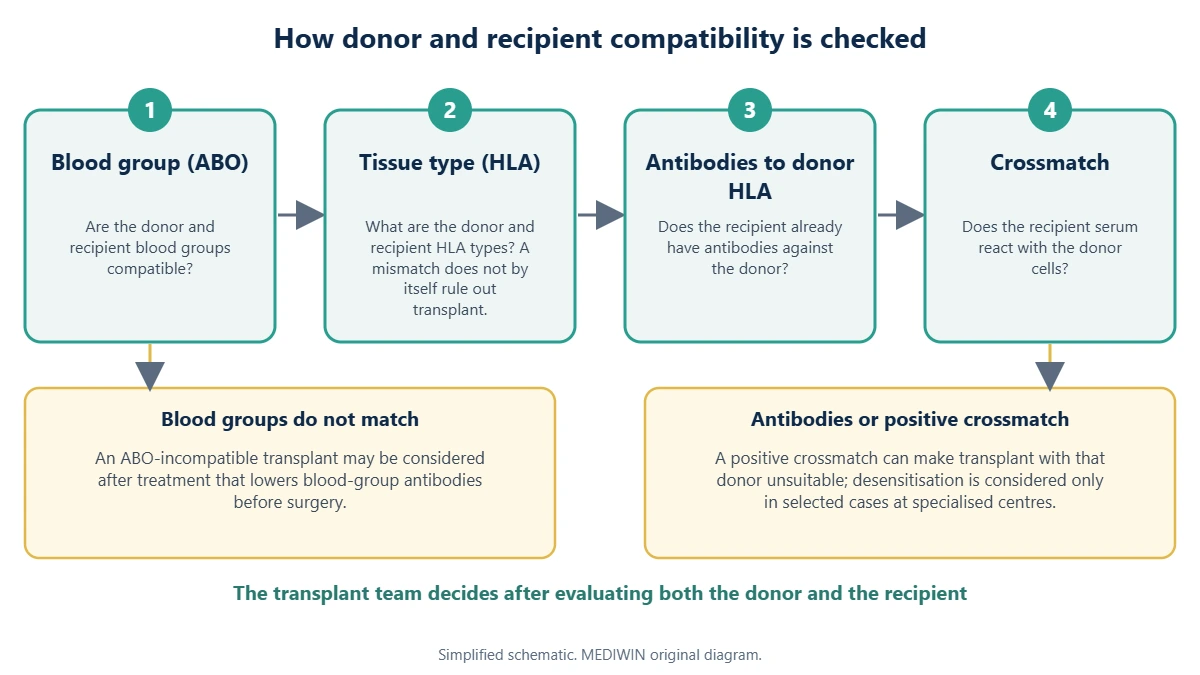
Compatibility is checked in steps: blood group (ABO), tissue type (HLA), antibodies in the recipient’s blood against the donor’s HLA, and a crossmatch that mixes the recipient’s serum with the donor’s cells [1]. A positive HLA crossmatch signals a substantial risk of antibody-mediated rejection and can make transplant with that donor unsuitable, although some specialised centres consider desensitisation in selected cases. ABO incompatibility is a separate question.
When blood groups do not match, an ABO-incompatible transplant may be possible after desensitisation, in which antibodies are lowered before the operation. In the Korean Organ Transplantation Registry, which followed 6,129 kidney transplants from 2014 to 2019, 17.4% were ABO-incompatible [3]. A meta-analysis of 26 studies found one-year graft survival of 96% after ABO-incompatible transplant and 98% after compatible transplant, with more antibody-mediated rejection, severe non-viral infection and bleeding in the incompatible group [4]. Whether this route is reasonable for a specific donor and recipient is a decision for the transplant team.
What Korean registry data show, and what they do not
In the same Korean registry, 64.8% of kidney transplants used living donors, 15.0% were performed before dialysis, and spouses were the largest group of living donors. Patient survival was 98.4% at one year and 95.8% at five years, and the transplanted kidney was still working in 97.1% at one year and 90.5% at five years; biopsy-proven acute rejection occurred in 17.0% during an average follow-up of 3.8 years [3].
These are results from a nationwide Korean registry cohort, mostly of Korean patients, and not necessarily every kidney transplant performed in Korea. They are not hospital-specific results, they do not predict the outcome for any individual, and they were not measured in patients who return abroad soon after surgery, where follow-up may be harder to organise [3].
Which records a Korean team needs
- For the recipient: a recent nephrology summary with the cause of kidney disease, current eGFR or dialysis details (type, start date, schedule), and recent blood and urine tests.
- Blood group and, if already done, HLA typing and anti-HLA antibody results, with any history of previous transplants, blood transfusions or pregnancies.
- Heart tests such as ECG and echocardiography, chest imaging, and any imaging of the abdomen and pelvic blood vessels.
- Infection screening results (hepatitis B and C, HIV, tuberculosis) and age-appropriate cancer screening.
- For the donor: age, blood group, blood pressure, kidney function, any long-term illness and medicines, and official documents proving the family relationship.
- A current medication list for both people.
Missing compatibility and relationship documents are common reasons a document-based review cannot move forward. The hospital will state which tests must be repeated in Korea.
Before travelling to Korea
- Ask your nephrologist whether you are stable enough to travel, and keep dialysis arranged until the Korean team confirms a date.
- Confirm that the donor is willing without pressure and understands that they can withdraw at any time before surgery.
- Ask how long the recipient and the donor are each expected to stay in Korea, and what happens if the evaluation in Korea finds a problem.
- Check that the anti-rejection medicines, the blood tests needed to monitor them and transplant follow-up will be available at home, and that the donor has a follow-up plan after returning.
- Read our kidney transplant page and the overview of serious illness treatment in Korea for how transplant cases are coordinated.
Frequently asked questions
Can a friend donate a kidney to me in Korea?
For a patient travelling from abroad, this should not be expected. Korean law does not rule out every unrelated donor, but donation outside the family relationships defined in the Act needs prior approval from the national transplant agency and additional review [6], and each hospital applies its own rules. MEDIWIN does not coordinate cases with an unrelated donor.
My relative has a different blood group. Is transplant still possible?
Possibly. ABO-incompatible transplants are performed in Korea after treatment that lowers blood-group antibodies, but they carry more risk of rejection, infection and bleeding than compatible transplants [3][4]. The transplant team decides after testing both people.
Do I have to start dialysis before a transplant?
No. International guidance identifies a living-donor transplant before dialysis as the preferred option for suitable candidates and recommends referral early enough to plan it [1]. Whether that is possible depends on how quickly kidney function is falling and on the evaluation of both recipient and donor.
How do I get a second opinion without travelling first?
A document-based review is the usual starting point. See our second opinion page for what can and cannot be answered from records alone, and our treatment cost page for how hospitals prepare written cost estimates after reviewing records.
Arranging a document review
MEDIWIN can transmit the records listed above to a registered medical institution in Korea and arrange scheduling, interpretation, and support with the hospital-issued documents that a visa application may require. The medical opinion is issued by that hospital’s physician. Please send written records only at first contact, and not through public comments; MEDIWIN will explain the submission method, which institution the records go to, and the consent needed, before any medical documents are requested.
References
- Chadban SJ, Ahn C, Axelrod DA, et al. KDIGO Clinical Practice Guideline on the Evaluation and Management of Candidates for Kidney Transplantation. Transplantation. 2020;104(4S1):S11–S103. doi:10.1097/TP.0000000000003136
- Lentine KL, Kasiske BL, Levey AS, et al. KDIGO Clinical Practice Guideline on the Evaluation and Care of Living Kidney Donors. Transplantation. 2017;101(8S):S7–S105. doi:10.1097/TP.0000000000001769
- Jeon HJ, Koo TY, Ju MK, et al. The Korean Organ Transplantation Registry (KOTRY): an overview and summary of the kidney-transplant cohort. Kidney Research and Clinical Practice. 2022;41(4):492–507. doi:10.23876/j.krcp.21.185
- de Weerd AE, Betjes MGH. ABO-Incompatible Kidney Transplant Outcomes: A Meta-Analysis. Clinical Journal of the American Society of Nephrology. 2018;13(8):1234–1243. doi:10.2215/CJN.00540118
- Muzaale AD, Massie AB, Wang MC, et al. Risk of End-Stage Renal Disease Following Live Kidney Donation. JAMA. 2014;311(6):579–586. doi:10.1001/jama.2013.285141
- Act on Organ Transplantation, etc. (장기등 이식에 관한 법률), Republic of Korea; current consolidated text on the Korean Law Information Center. www.law.go.kr
- The Declaration of Istanbul on Organ Trafficking and Transplant Tourism (2018 Edition). Transplantation. 2019;103(2):218–219. doi:10.1097/TP.0000000000002540
Image credits: both schematic figures are original diagrams produced by MEDIWIN for this article. The photograph is an illustrative image; it does not show a real hospital, team or patient. No third-party image was used or adapted.
Written by MEDIWIN Editorial Team, summarising the published sources listed above. This article has not been reviewed by a nephrologist or a transplant surgeon, and nothing in it should be read as a clinical opinion. It should not be used to decide on transplant or donation, to change prescribed treatment or dialysis, or to delay urgent medical assessment; those decisions belong to the treating medical team.
This article is general information and not medical advice. MEDIWIN Co., Ltd. is a foreign-patient facilitator registered in Korea (Registration No. A-2022-01-01-4465) and is not a medical institution; diagnoses and treatment decisions are made by physicians at independently operated registered medical institutions.