




Last updated: 12 October 2026 · Written by MEDIWIN Editorial Team · How we selected sources: specialist-society guidelines first, then key trials and reviews; each reference was checked against its bibliographic record and, where the full text was openly available, against the publication itself.
Liver cancer treatment in Korea is not chosen from the tumour alone. For hepatocellular carcinoma, the most common primary liver cancer, Korean teams weigh three things together: the tumour (size, number, and whether it invades a vein), how much working liver remains, and the patient’s general condition [1][3]. Those inputs decide whether surgical removal, local ablation, transarterial treatment or a liver transplant is discussed, and they are reassessed as treatment proceeds. Transplant is one option among several, not the end point of a ladder. For a medically stable patient living abroad, a document-based second opinion is normally the first step rather than travel. Anyone with jaundice, vomiting blood, confusion or severe abdominal pain needs urgent assessment where they are, not a plan to travel.
Key points
- The Korean guideline uses the modified UICC staging system as its primary framework, with the BCLC and AJCC/UICC systems used alongside it [1].
- Surgical resection is recommended as the treatment of choice for a resectable single tumour when liver function is preserved; resection may also be considered with up to three nodules [1].
- For a single tumour under 2 cm, resection and radiofrequency ablation are both recommended; for a single tumour of 2–3 cm where resection is difficult, ablation is considered preferentially [1].
- Liver transplantation is recommended as a primary option for tumours meeting the Milan criteria — one tumour of 5 cm or less, or up to three tumours each 3 cm or less, with no vascular invasion or spread outside the liver on imaging before transplantation — when the patient is a poor candidate for resection because of tumour location, liver dysfunction or clinically significant portal hypertension [1][2][4].
- Beyond the Milan criteria, transplantation is recommended after the disease has been brought within those criteria by downstaging treatment [1]. The Korean guideline also allows expanded criteria beyond Milan to be applied in selected patients who have no definite vascular invasion or spread outside the liver and who respond well to non-surgical treatment, as a weaker recommendation [1]. Transarterial chemoembolisation is the locoregional treatment most often used before transplantation in Korea, with downstaging reported in 24–63% of cases in published series [2]; a reduction in stage is not the same as meeting transplant criteria, or as actually being transplanted.
- The evidence for bridging and downstaging treatment is not from randomised trials: a systematic review found no randomised controlled trials and judged the comparative studies to be at high risk of bias [5].
- Every option carries risk — bleeding, infection and liver failure after surgery; thermal injury to nearby structures after ablation; post-embolisation syndrome and liver decompensation after transarterial treatment; and rejection, serious infection on lifelong immunosuppression, and death related to the procedure after transplantation [1][2].

Who MEDIWIN is, and what it does not do
MEDIWIN Co., Ltd. is a foreign-patient facilitator registered in Korea (Registration No. A-2022-01-01-4465) and is not a medical institution. MEDIWIN provides administrative coordination only: at the patient’s request it can transmit submitted records to an independently operated registered medical institution, and arrange scheduling, interpretation, the visa letter and travel-related support. MEDIWIN does not recommend a procedure, determine whether an operation or a transplant is suitable, diagnose a condition or provide treatment.
Any medical opinion is issued by that institution’s physician, not by MEDIWIN. A document-based opinion is provisional; it is not a diagnosis or a final treatment plan, which are determined by the treating physician after assessment in person. MEDIWIN does not find, recruit or screen living organ donors; donor eligibility is decided by the hospital and governed by the laws of both countries. Coordination is available to people aged 18 or over living outside Korea.
What hepatocellular carcinoma is, and where it begins
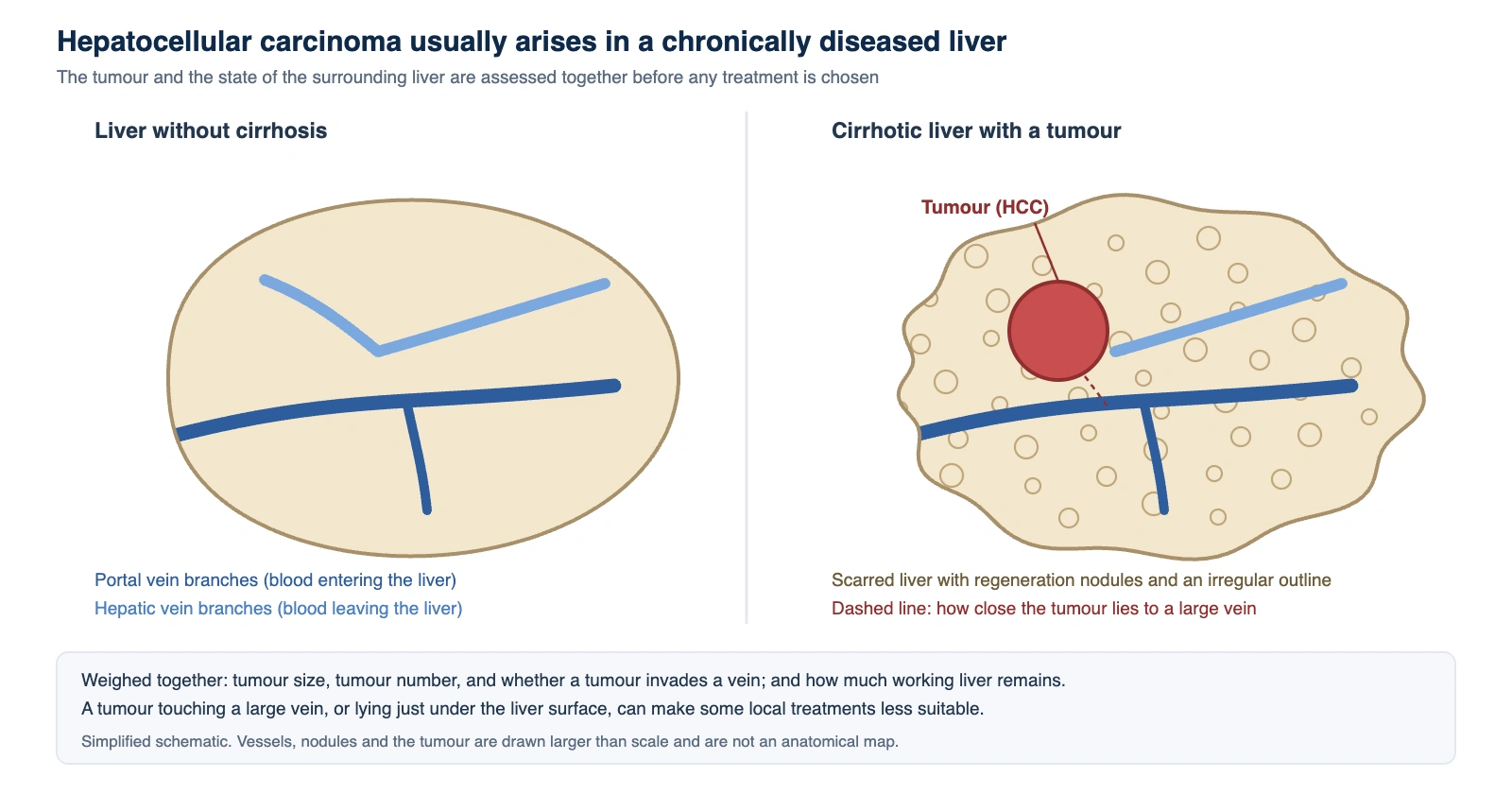
Hepatocellular carcinoma starts in the liver cells themselves. It usually develops in a liver already injured by long-standing hepatitis B or C infection, alcohol-related disease or fatty liver disease, which is why the health of the liver around the tumour matters as much as the tumour. A tumour lying against a large vein or just under the liver surface is harder to treat with ablation: when 3 mm or more of the tumour surface touches a portal or hepatic vein, heat is carried away by the blood flow and the treatment may be less effective [2].
How the options are weighed

| Situation | Options usually discussed | What mainly decides |
|---|---|---|
| Single removable tumour, liver function preserved | Surgical resection, recommended as the treatment of choice [1] | Liver function, portal hypertension, and the volume of liver left after surgery [1][2] |
| Single tumour under 2 cm | Resection and radiofrequency ablation, both recommended [1] | Tumour position, liver function, and long-term recurrence risk [1] |
| Single tumour 2–3 cm, resection difficult | Ablation considered preferentially; microwave ablation may be used as an alternative for tumours of 3 cm or less [1] | Contact with large vessels, the bile duct or the liver surface [1][2] |
| Within the Milan criteria, but a poor candidate for resection | Liver transplantation, recommended as a primary option [1][2] | Tumour location, liver dysfunction, clinically significant portal hypertension [1] |
| Beyond the Milan criteria, resection not feasible | Transplantation after the disease has been downstaged to within the Milan criteria [1]; expanded criteria beyond Milan may be applied in selected patients, as a weaker recommendation [1] | Response to downstaging treatment; absence of definite vascular invasion or spread outside the liver [1] |
| Not suitable for resection, ablation or transplantation, general condition good | Conventional transarterial chemoembolisation [1] | Performance status, liver function, and how the tumours are distributed [1] |
Published outcomes differ with the situation treated and are not promises for any individual. In the Korean guideline, reported postoperative mortality after liver resection for this cancer is less than 1–3% in published series, with 5-year overall survival of 46% to 69.5% and recurrence within five years in 43.7% to 77% of patients [2]. For transplantation within the Milan criteria, European and American registries reported 5-year overall survival of 65% to 78%, similar to patients transplanted without liver cancer [2]; these are not Korean figures. Korean centres commonly use the indocyanine green 15-minute retention test alongside the Child-Pugh class before surgery, and major resection is recommended only when that value is 10% or less [2].
Transplant waiting, bridging and downstaging
Living-donor transplantation is currently the main form of liver transplantation for this cancer in Korea, and patients with liver cancer account for only 2–5% of deceased-donor liver transplants there [2]. That is a description of Korean practice, not a suggestion: MEDIWIN does not arrange donors, and whether a living donation is lawful and medically acceptable is decided by the hospital and by the law of the patient’s own country as well as Korea’s.
While a patient waits, the tumour can progress to the point where transplantation is no longer possible. The Korean guideline reports a dropout rate of 15–30% per year, with dropout rates of 0–25% reported in patients who received bridging treatment, and notes that these figures come from Western studies and may not apply to Korea [2]. Bridging treatment should be considered when the timing of transplantation is hard to predict [1]. The limits of this evidence are worth stating plainly: a systematic review of treatments given to patients awaiting transplantation found no randomised controlled trials, and the comparative studies it found were at high risk of bias [5].
Which records a Korean team needs
- The full radiology report and the images themselves on CD or DVD — multiphase liver CT or MRI, taken within the last 2–3 months where possible.
- Any biopsy or pathology report, if a biopsy was performed.
- Recent blood tests: liver function panel, clotting tests, alpha-fetoprotein, hepatitis B and C results, and kidney function.
- A summary of treatment already given, with dates: any surgery, ablation, transarterial treatment, radiotherapy or systemic treatment, and the response to each.
- A current medication list, including antiviral treatment for hepatitis.
- Any record of cirrhosis complications: ascites, variceal bleeding, encephalopathy, or a previous decompensation episode.
Incomplete imaging is the most common reason a document-based opinion cannot be given. A report without the images is rarely enough, because the number and position of the tumours have to be read directly.
Before travelling to Korea
- Ask your current team whether your condition is stable enough to travel, and keep urgent problems — fever, jaundice, bleeding, confusion — under local care first.
- Ask what the Korean institution would need to decide, and whether a provisional opinion can be given from documents alone.
- Ask how long an assessment is expected to take, and what would happen if the plan changes after examination in person.
- Plan for follow-up at home: this cancer recurs often, and someone must monitor imaging and liver function after you return.
- Read our liver cancer and transplant page and the longer article on liver transplantation in Korea for what the transplant route itself involves.
Frequently asked questions
Does a bigger tumour mean a transplant instead of surgery?
No. Size is one input among several. A single large tumour in a liver that works well may be removed surgically, while a small tumour in a poorly functioning liver, or with clinically significant portal hypertension, may make transplantation the option that is discussed first [1].
Can treatment given at home count towards downstaging?
It can, if it is documented. The Korean team needs the imaging before and after each treatment, with dates, to judge whether the disease has been brought within the Milan criteria [1][2]. Reports alone, without the images, are usually not enough.
Is chemoembolisation only used when nothing else is possible?
It is recommended for patients in good general condition who are not eligible for resection, transplantation or local ablation [1], but it is also used before transplantation as bridging or downstaging treatment [1][2]. The purpose differs, and so does what counts as success.
How do I get a second opinion without travelling first?
A document-based review is the usual starting point. See our second opinion page for what can and cannot be answered from records alone.
Arranging a document review
MEDIWIN can transmit the records listed above to a registered medical institution in Korea and arrange scheduling, interpretation, and support with the hospital-issued documents that a visa application may require. The medical opinion is issued by that hospital’s physician. Please send written records only at first contact, and not through public comments; MEDIWIN will explain the submission method, which institution the records go to, and the consent needed, before any medical documents are requested.
References
- Korean Liver Cancer Association (KLCA) and National Cancer Center (NCC) Korea. 2026 KLCA-NCC Korea practice guidelines for the management of hepatocellular carcinoma. Clinical and Molecular Hepatology. Published online 19 August 2026. doi:10.3350/cmh.2026.0943
- Korean Liver Cancer Association (KLCA) and National Cancer Center (NCC) Korea. 2022 KLCA-NCC Korea practice guidelines for the management of hepatocellular carcinoma. Clinical and Molecular Hepatology. 2022;28(4):583–705. doi:10.3350/cmh.2022.0294
- Reig M, Forner A, Rimola J, et al. BCLC strategy for prognosis prediction and treatment recommendation: the 2022 update. Journal of Hepatology. 2022;76(3):681–693. doi:10.1016/j.jhep.2021.11.018
- Mazzaferro V, Regalia E, Doci R, et al. Liver transplantation for the treatment of small hepatocellular carcinomas in patients with cirrhosis. New England Journal of Medicine. 1996;334(11):693–699. doi:10.1056/NEJM199603143341104
- Kulik L, Heimbach JK, Zaiem F, et al. Therapies for patients with hepatocellular carcinoma awaiting liver transplantation: a systematic review and meta-analysis. Hepatology. 2018;67(1):381–400. doi:10.1002/hep.29485
Image credits: both schematic figures are original diagrams produced by MEDIWIN for this article. The photograph is an illustrative image; it does not show a real hospital, team or patient. No third-party image was used or adapted.
Written by MEDIWIN Editorial Team, summarising the published sources listed above. This article has not been reviewed by a hepatologist, a liver surgeon or an interventional radiologist, and nothing in it should be read as a clinical opinion. It should not be used to judge transplant eligibility, to change prescribed treatment, or to delay urgent medical assessment; those decisions belong to the treating medical team.
This article is general information and not medical advice. MEDIWIN Co., Ltd. is a foreign-patient facilitator registered in Korea (Registration No. A-2022-01-01-4465) and is not a medical institution; diagnoses and treatment decisions are made by physicians at independently operated registered medical institutions.