


Last updated: 26 October 2026 · Written by MEDIWIN Editorial Team · How we selected sources: specialist-society guidelines first, then the randomised trials behind current practice in Europe and Asia; each reference was checked against its bibliographic record and, where the abstract or full text was openly available, against the publication itself.
Oesophageal cancer treatment (esophageal cancer treatment) for a tumour that has not spread to distant organs is usually planned by a multidisciplinary team around two questions: how deep and how widespread the tumour is locally, and whether it is a squamous cell carcinoma or an adenocarcinoma. Depending on the answers, the plan may be endoscopic removal, chemoradiotherapy or chemotherapy followed by surgery, chemoradiotherapy without planned surgery, or immunotherapy after surgery [1][2][4][5][6]. For a medically stable patient living abroad, a document-based second opinion is normally the first step rather than travel. Anyone who cannot swallow liquids or saliva, vomits blood, passes black stools, coughs or chokes when drinking, has breathing difficulty, or develops a temperature of 38°C or higher or shaking chills during chemotherapy needs urgent care where they are.
Key points
- The two main types behave differently: squamous cell carcinoma usually arises in the upper and middle oesophagus, and adenocarcinoma in the lower oesophagus and the junction with the stomach; treatment choices partly depend on the type [1].
- Staging combines endoscopy with biopsy, CT, and often PET-CT and endoscopic ultrasound, because the depth of invasion and lymph node involvement decide whether endoscopic treatment, surgery or combined treatment is appropriate [1].
- For locally advanced tumours, chemoradiotherapy before surgery improved long-term survival compared with surgery alone in the CROSS trial [2][3].
- For resectable locally advanced adenocarcinoma, perioperative FLOT chemotherapy gave longer survival than the CROSS approach in the ESOPEC trial; for squamous cell carcinoma, a Japanese trial found three-drug chemotherapy before surgery better than two-drug chemotherapy [4][5].
- After chemoradiotherapy, some patients have no detectable tumour; active surveillance instead of immediate surgery has been tested in an organised programme, but it requires strict follow-up and is not appropriate for everyone [8].
Who MEDIWIN is, and what it does not do
MEDIWIN Co., Ltd. is a foreign-patient facilitator registered in Korea (Registration No. A-2022-01-01-4465) and is not a medical institution. MEDIWIN provides administrative coordination only: at the patient’s request it can transmit submitted records to an independently operated registered medical institution, and arrange scheduling, interpretation, the visa letter and travel-related support. MEDIWIN does not recommend a procedure, determine whether an operation or a transplant is suitable, diagnose a condition or provide treatment.
Any medical opinion is issued by that institution’s physician, not by MEDIWIN. A document-based opinion is provisional; it is not a diagnosis or a final treatment plan, which are determined by the treating physician after assessment in person. Coordination is available to people aged 18 or over living outside Korea.
What “non-metastatic” oesophageal cancer means

Non-metastatic oesophageal cancer means that the tumour has not spread to distant organs such as the liver, lungs or distant lymph nodes. It still ranges from very early cancers confined to the inner lining to tumours that have grown through the wall of the oesophagus or spread to regional lymph nodes, called locally advanced disease. Endoscopy with biopsy confirms the type of cancer. CT of the chest and abdomen looks for spread, PET-CT is commonly added for patients who may have curative treatment, and endoscopic ultrasound can estimate how deep the tumour reaches and whether nearby lymph nodes look involved. For tumours in the upper and middle oesophagus close to the windpipe, an examination of the airway may also be needed [1].
The tumour’s position matters. Cancers in the neck part of the oesophagus are usually treated with chemoradiotherapy rather than surgery, because an operation there can affect the throat and voice box. Tumours in the middle and lower oesophagus and at the junction with the stomach are more often treated with a combination that includes oesophagectomy, the operation that removes part of the oesophagus and reconstructs the passage, usually with the stomach [1]. Tumours at the junction with the stomach need precise classification, because some are staged and treated as oesophageal cancer and others as stomach cancer [1].
How the treatment plan is chosen

The multidisciplinary team, including an oesophageal surgeon, a medical oncologist, a radiation oncologist, a gastroenterologist, a radiologist and a pathologist, considers the stage, the tumour type and position, the patient’s fitness for major surgery, nutrition and the patient’s priorities. The table summarises the main approaches and the trials behind them.
| Approach | What it involves | What the evidence shows |
|---|---|---|
| Endoscopic resection | For carefully selected superficial cancers, particularly low-risk tumours confined to the inner lining (T1a), the tumour is removed through an endoscope; the specimen is checked for depth, differentiation, invasion of small vessels and margins | An organ-sparing option only for selected early tumours; unfavourable features usually lead to additional treatment such as surgery or chemoradiotherapy [1] |
| Chemoradiotherapy, then surgery (CROSS) | About five weeks of radiotherapy with weekly carboplatin and paclitaxel, then oesophagectomy | Median survival 49.4 vs 24.0 months with surgery alone; 10-year survival 38% vs 25%, with a larger gain in squamous cell carcinoma [2][3] |
| Chemotherapy before and after surgery (FLOT), for adenocarcinoma | Four cycles of FLOT chemotherapy before and four after oesophagectomy | In ESOPEC, in patients with resectable locally advanced adenocarcinoma, 3-year survival 57.4% vs 50.7% with the CROSS approach; this does not make CROSS inappropriate for every patient [4][9] |
| Chemotherapy before surgery for squamous cell carcinoma (JCOG1109) | Docetaxel, cisplatin and fluorouracil (DCF) before oesophagectomy, the approach tested in Japan | 3-year survival 72.1% with DCF vs 62.6% with cisplatin and fluorouracil (CF); CF plus radiotherapy (68.3%) was not significantly better than CF; the trial did not compare DCF with CROSS; severe low white-cell counts in about 85% with DCF [5] |
| Definitive chemoradiotherapy without planned surgery | Chemotherapy with a full course of radiotherapy without planned oesophagectomy; salvage surgery may be possible for selected patients if cancer persists or returns, but it is more difficult after full-dose radiotherapy | Often used for cancers in the neck part of the oesophagus and for patients who cannot have or decline major surgery, particularly with squamous cell carcinoma [1] |
| Nivolumab after surgery (CheckMate 577) | Up to one year of immunotherapy for patients with stage II–III cancer who still had cancer in the operative specimen after chemoradiotherapy and complete (R0) resection | Median disease-free survival 22.4 vs 11.0 months with placebo in the first analysis [6]; the final overall survival difference was not statistically significant [7] |
These trials enrolled different patients, and some were limited to one tumour type, so their results should not be compared directly with each other. Practice also differs between regions: chemoradiotherapy before surgery is widely used in Europe and North America, while chemotherapy before surgery has been the main approach for squamous cell carcinoma in Japan [1][5].
What the trials show, and what they do not
In CROSS, 368 patients were enrolled and 366 analysed; median overall survival was 49.4 months with chemoradiotherapy and surgery and 24.0 months with surgery alone, and among 161 patients who had surgery after chemoradiotherapy, 47 (29%) had no remaining cancer in the specimen [2]. At ten years, overall survival was 38% vs 25%; in squamous cell carcinoma it was 46% vs 23%, and in adenocarcinoma 36% vs 26% [3]. ESOPEC randomised 438 patients with resectable, locally advanced adenocarcinoma to perioperative FLOT or CROSS chemoradiotherapy, each followed by surgery; 3-year overall survival was 57.4% vs 50.7%, and median survival 66 vs 37 months [4]. ESMO issued an interim guideline update on locally advanced adenocarcinoma in 2025 [9]. JCOG1109 randomised 601 Japanese patients with resectable locally advanced squamous cell carcinoma; 3-year overall survival was 62.6% with cisplatin and fluorouracil (CF), 72.1% with DCF and 68.3% with CF plus radiotherapy. DCF improved survival significantly compared with CF, CF plus radiotherapy did not, and the trial did not compare DCF with CROSS [5].
In CheckMate 577, patients who still had cancer in the specimen after chemoradiotherapy and complete resection had longer disease-free survival with nivolumab than with placebo: 22.4 vs 11.0 months in the first analysis [6] and 21.8 vs 10.8 months with longer follow-up [7]. In the final analysis presented in 2025, median overall survival was 51.7 vs 35.3 months, but this difference did not reach statistical significance [7]. Nivolumab is not indicated after every oesophagectomy; the trial did not include patients treated with FLOT or those with no remaining cancer in the specimen [6]. None of these figures predicts the outcome for an individual patient or a particular hospital.
Active surveillance after chemoradiotherapy
After chemoradiotherapy, some patients have no detectable tumour on endoscopy with biopsies, endoscopic ultrasound and PET-CT, which is called a clinical complete response. A clinical complete response does not prove that every cancer cell has gone. In the Dutch SANO trial, which included 309 patients with a clinical complete response (198 under active surveillance and 111 with standard surgery), 2-year overall survival was 74% with active surveillance and 71% with standard surgery; surveillance met the trial’s predefined non-inferiority criterion, but this does not establish equivalent long-term survival or cancer control [8]. Endoscopy and scans cannot exclude every microscopic deposit, particularly in lymph nodes. Active surveillance means repeated specialised endoscopy with biopsies, endoscopic ultrasound and imaging, with rapid access to surgery if the tumour regrows; it is not simply declining surgery after a clear scan, and follow-up is still relatively short [8].
Side effects and life after treatment
Chemoradiotherapy can cause painful swallowing, tiredness, low blood counts and, rarely, inflammation of the lungs or heart [1][2]. Three-drug chemotherapy regimens such as DCF and FLOT cause more low white-cell counts and infections than simpler regimens; in JCOG1109, severe low white-cell counts occurred in about 85% of patients receiving DCF and fever with low white-cell counts in about 16% [5]. Oesophagectomy is major surgery with risks that include pneumonia, a leak where the new connection is made, bleeding, blood clots, voice changes, prolonged recovery and death; longer-term effects can include reflux, swallowing difficulty, dumping symptoms after meals and weight loss [1]. Tumours involving the windpipe, and occasionally treatment-related tissue damage, can cause an abnormal connection between the oesophagus and the airway (fistula); new coughing on swallowing, repeated chest infections or breathlessness need prompt assessment [1]. Nivolumab can cause immune-related inflammation of organs such as the lungs, bowel, liver or thyroid, sometimes after treatment has stopped; new breathlessness or persistent diarrhoea needs prompt assessment [6]. Weight loss and difficulty swallowing are common at diagnosis, so many patients need nutritional support, sometimes through a feeding tube, before and during treatment [1].
Which records a Korean team needs
- The endoscopy report with photographs, and the pathology report of the biopsy, including the cancer type, and, if possible, the slides or tissue blocks for review.
- The original CT images, preferably in DICOM format on CD, DVD or a secure download, with the report, and PET-CT and endoscopic ultrasound results if they have been done.
- Any airway examination (bronchoscopy) report for tumours in the upper or middle oesophagus.
- A summary of any treatment already started, with dates, drugs, radiotherapy dose and the latest response assessment.
- Recent blood tests, weight change over recent months and how well you can swallow solids and liquids.
- A current medication list and a summary of other conditions, such as heart or lung disease, diabetes or liver disease.
A written report without the images may not be enough, because a specialist may need to review the images to confirm the tumour’s length, depth and lymph node involvement.
Before travelling to Korea
- Ask your current doctors whether a delay for travel is safe, and do not interrupt treatment that has already started without discussing it.
- Ask the Korean institution whether a provisional opinion can be given from documents, and which tests would be repeated on arrival.
- Ask how many weeks each phase is expected to take, because treatment before surgery, the operation and recovery can together last several months, and whether parts can be given closer to home.
- If swallowing is difficult, ask how nutrition will be managed during travel and treatment.
- Agree in advance how chemotherapy, recovery after surgery, nutrition, complications and long-term follow-up will be coordinated with doctors in your home country.
- Read our stomach and colorectal cancer page and the overview of serious illness treatment in Korea for how cancer cases are coordinated.
Frequently asked questions
Will I always need an operation?
Not always. Very early tumours may be removed endoscopically, cancers in the neck part of the oesophagus are usually treated with chemoradiotherapy, and some patients are treated with chemoradiotherapy alone because of their tumour type, position or general health. For many locally advanced tumours, surgery remains part of the standard plan [1].
Is the treatment different for squamous cell carcinoma and adenocarcinoma?
Partly. Both can be treated with chemoradiotherapy and surgery, but for resectable locally advanced adenocarcinoma perioperative FLOT chemotherapy gave longer survival in ESOPEC, and for squamous cell carcinoma definitive chemoradiotherapy and, in Japan, DCF chemotherapy before surgery are established options [1][4][5].
Can I avoid surgery if the tumour disappears after chemoradiotherapy?
Possibly, in selected patients and at centres with a structured surveillance programme. Active surveillance after a clinical complete response met the non-inferiority criterion for 2-year survival in SANO, but it needs frequent endoscopy with biopsies and scans, and rapid surgery if the tumour regrows [8].
How do I get a second opinion without travelling first?
A document-based review is the usual starting point. See our second opinion page for what can and cannot be answered from records alone, and our treatment cost page for how hospitals prepare written cost estimates after reviewing records.
Arranging a document review
MEDIWIN can transmit the records listed above to a registered medical institution in Korea and arrange scheduling, interpretation, and support with the hospital-issued documents that a visa application may require. The medical opinion is issued by that hospital’s physician. Please send written records only at first contact, and not through public comments; MEDIWIN will explain the submission method, which institution the records go to, and the consent needed, before any medical documents are requested.
References
- Obermannová R, Alsina M, Cervantes A, et al. Oesophageal cancer: ESMO Clinical Practice Guideline for diagnosis, treatment and follow-up. Annals of Oncology. 2022;33(10):992–1004. doi:10.1016/j.annonc.2022.07.003
- van Hagen P, Hulshof MCCM, van Lanschot JJB, et al. Preoperative chemoradiotherapy for esophageal or junctional cancer. New England Journal of Medicine. 2012;366(22):2074–2084. doi:10.1056/NEJMoa1112088
- Eyck BM, van Lanschot JJB, Hulshof MCCM, et al. Ten-year outcome of neoadjuvant chemoradiotherapy plus surgery for esophageal cancer: the randomized controlled CROSS trial. Journal of Clinical Oncology. 2021;39(18):1995–2004. doi:10.1200/JCO.20.03614
- Hoeppner J, Brunner T, Schmoor C, et al. Perioperative chemotherapy or preoperative chemoradiotherapy in esophageal cancer. New England Journal of Medicine. 2025;392(4):323–335. doi:10.1056/NEJMoa2409408
- Kato K, Machida R, Ito Y, et al. Doublet chemotherapy, triplet chemotherapy, or doublet chemotherapy combined with radiotherapy as neoadjuvant treatment for locally advanced oesophageal cancer (JCOG1109 NExT): a randomised, controlled, open-label, phase 3 trial. The Lancet. 2024;404(10447):55–66. doi:10.1016/S0140-6736(24)00745-1
- Kelly RJ, Ajani JA, Kuzdzal J, et al. Adjuvant nivolumab in resected esophageal or gastroesophageal junction cancer. New England Journal of Medicine. 2021;384(13):1191–1203. doi:10.1056/NEJMoa2032125
- Kelly RJ, et al. Adjuvant nivolumab in resected esophageal or gastroesophageal junction cancer following neoadjuvant chemoradiotherapy: first results of overall survival from CheckMate 577. Journal of Clinical Oncology. 2025;43(16 suppl):4000 (conference abstract).
- van der Wilk BJ, Eyck BM, Wijnhoven BPL, et al. Neoadjuvant chemoradiotherapy followed by active surveillance versus standard surgery for oesophageal cancer (SANO trial): a multicentre, stepped-wedge, cluster-randomised, non-inferiority, phase 3 trial. The Lancet Oncology. 2025;26(4):425–436. doi:10.1016/S1470-2045(25)00027-0
- Obermannová RL, Leong T; ESMO Guidelines Committee. ESMO Clinical Practice Guideline interim update on the treatment of locally advanced oesophageal and oesophagogastric junction adenocarcinoma and metastatic squamous-cell carcinoma. ESMO Open. 2025;10(2):104134. doi:10.1016/j.esmoop.2025.104134
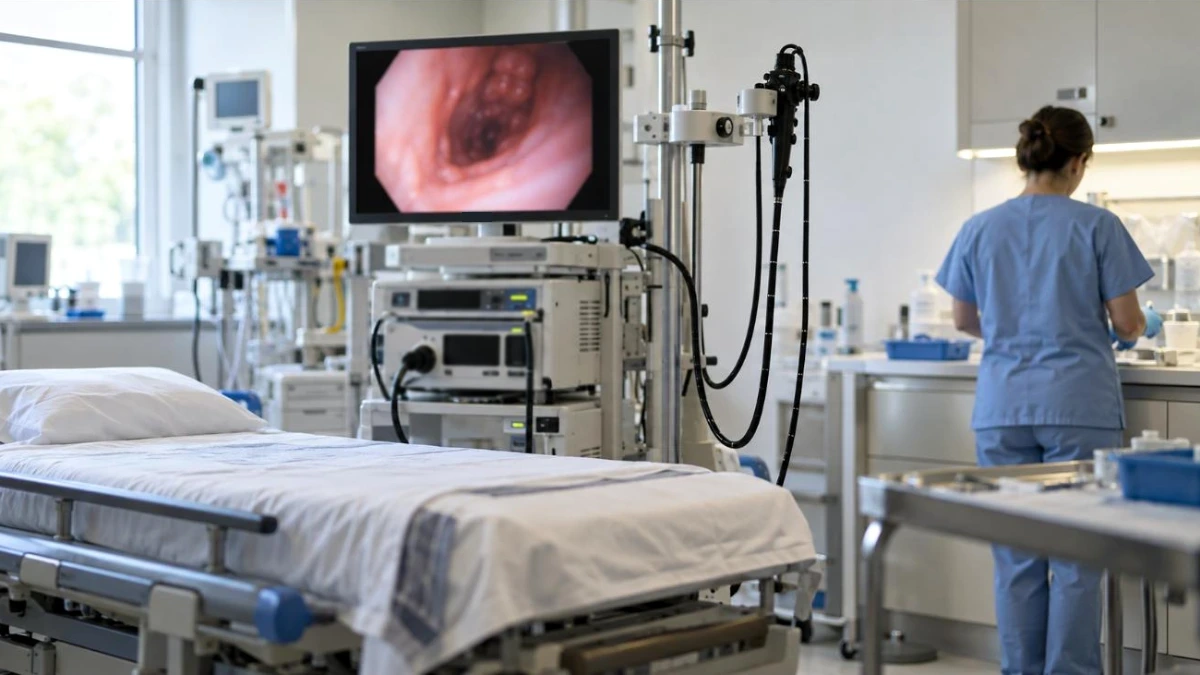
Image credits: both schematic figures are original diagrams produced by MEDIWIN for this article. The photograph is an illustrative image; it does not show a real hospital, team or patient. No third-party image was used or adapted.
Written by MEDIWIN Editorial Team, summarising the published sources listed above. This article has not been reviewed by an oesophageal surgeon or an oncologist, and nothing in it should be read as a clinical opinion. It should not be used to choose a treatment, to change prescribed treatment, or to delay urgent medical assessment; those decisions belong to the treating medical team.
This article is general information and not medical advice. MEDIWIN Co., Ltd. is a foreign-patient facilitator registered in Korea (Registration No. A-2022-01-01-4465) and is not a medical institution; diagnoses and treatment decisions are made by physicians at independently operated registered medical institutions.