


Last updated: 23 October 2026 · Written by MEDIWIN Editorial Team · How we selected sources: specialist-society guidelines first, then the randomised and prospective trials behind them and a US regulatory notice; each reference was checked against its bibliographic record and, where the abstract or full text was openly available, against the publication itself.
Locally advanced rectal cancer treatment is no longer a single fixed sequence of radiotherapy followed by surgery. Depending on the MRI findings, the tumour’s height in the rectum and its molecular profile, a multidisciplinary team may recommend chemoradiotherapy, a short course of radiotherapy, chemotherapy given before surgery, or, for some patients whose tumour disappears on treatment, close surveillance instead of immediate surgery [1][2][4][5][7]. For a medically stable patient living abroad, a document-based second opinion is normally the first step rather than travel. Anyone with heavy rectal bleeding, signs of bowel obstruction such as severe abdominal pain, swelling and vomiting, or a high fever during treatment needs urgent care where they are.
Key points
- A high-quality pelvic MRI is central to planning, because it shows how far the tumour extends beyond the bowel wall, whether lymph nodes or nearby veins are involved and how close the tumour is to the mesorectal fascia [1].
- Total neoadjuvant therapy, which gives chemotherapy and radiotherapy before planned surgery, improved disease-related treatment failure or disease-free survival in some randomised trials; results differ by regimen, and the RAPIDO regimen was followed by more local recurrences at longer follow-up [2][3][4].
- In selected patients suitable for sphincter-sparing surgery, chemotherapy alone before surgery, with radiotherapy kept for poor responders, was not inferior to chemoradiotherapy [5].
- In one organ-preservation trial, about half of patients in the better-performing arm had not needed major rectal surgery at five years, but this requires frequent check-ups and surgery if the tumour regrows [7].
- Testing the biopsy for mismatch repair deficiency (dMMR) or high microsatellite instability (MSI-H) can change the treatment approach: immunotherapy alone produced high clinical complete response rates in studies, and the US FDA granted accelerated approval to dostarlimab for this group in October 2026 [1][9][10].
Who MEDIWIN is, and what it does not do
MEDIWIN Co., Ltd. is a foreign-patient facilitator registered in Korea (Registration No. A-2022-01-01-4465) and is not a medical institution. MEDIWIN provides administrative coordination only: at the patient’s request it can transmit submitted records to an independently operated registered medical institution, and arrange scheduling, interpretation, the visa letter and travel-related support. MEDIWIN does not recommend a procedure, determine whether an operation or a transplant is suitable, diagnose a condition or provide treatment.
Any medical opinion is issued by that institution’s physician, not by MEDIWIN. A document-based opinion is provisional; it is not a diagnosis or a final treatment plan, which are determined by the treating physician after assessment in person. Coordination is available to people aged 18 or over living outside Korea.
What makes rectal cancer “locally advanced”
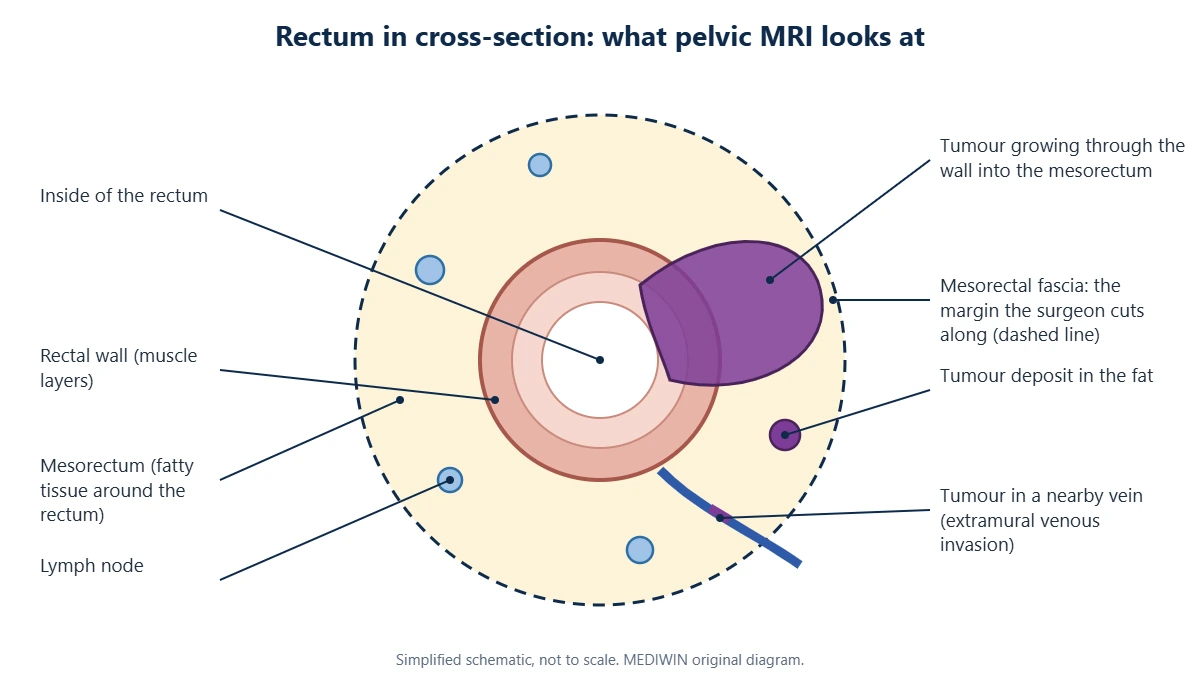
Locally advanced rectal cancer generally means a tumour that has not spread to distant organs but has grown through the muscle wall of the rectum into the surrounding fatty tissue (the mesorectum) or beyond, or has spread to nearby lymph nodes, commonly clinical stage II or III. Not every tumour in this group carries the same risk or needs the same treatment. High-resolution pelvic MRI assesses how far the tumour extends beyond the wall, regional and lateral lymph nodes, tumour growth into veins outside the wall (extramural venous invasion, EMVI) and the distance to the mesorectal fascia, the layer around the mesorectum along which the surgeon dissects. Together these findings estimate the risk that cancer will be left at the cut edge of the specimen, the circumferential resection margin, and guide how intensive treatment needs to be [1].
When MRI suggests that the mesorectal fascia is involved, the risk of a positive margin is higher, and treatment before surgery is used to improve local control and the chance of a complete removal; tumours growing into neighbouring organs may need more extensive surgery [1]. The tumour’s height above the anal opening and any involvement of the sphincter muscles also matter, because they affect whether the sphincter can be preserved.
How the treatment sequence is chosen
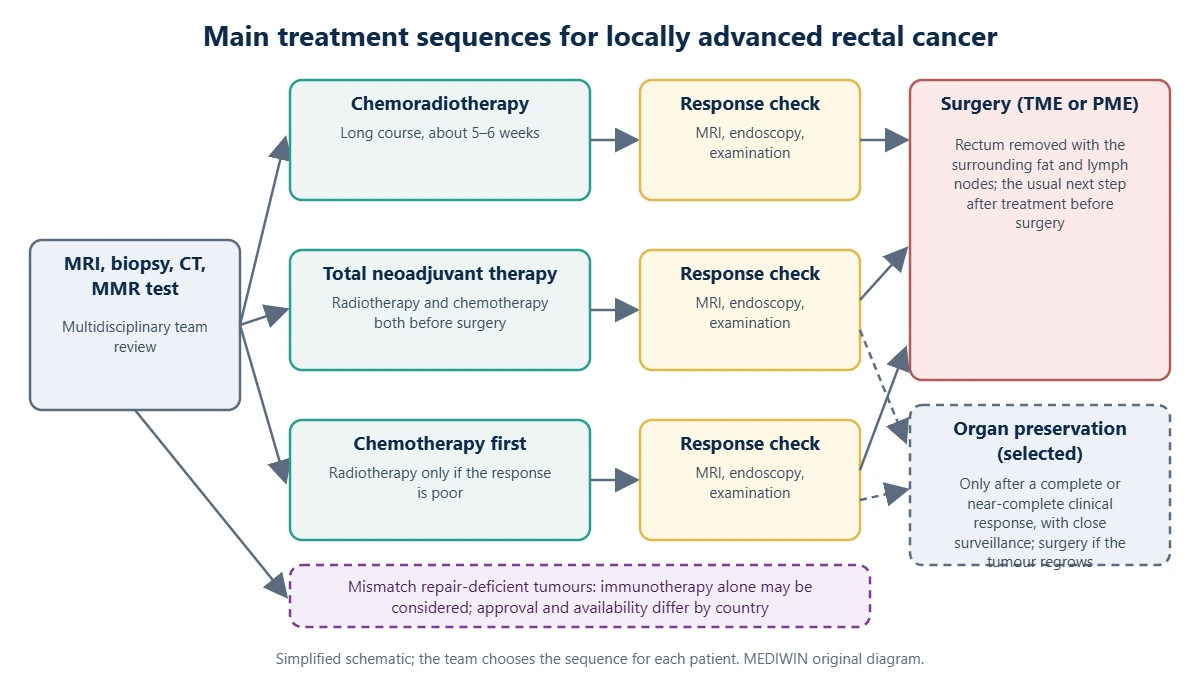
When surgery is needed for a tumour in the middle or lower rectum, the usual operation is total mesorectal excision (TME), in which the rectum is removed together with the fatty tissue and lymph nodes around it; for selected tumours in the upper rectum a partial mesorectal excision (PME) may be enough [1]. What changes most from patient to patient is the treatment before it. The table summarises the main approaches tested in randomised or prospective trials.
| Approach | What it involves | What the evidence shows |
|---|---|---|
| Long-course chemoradiotherapy, then surgery | Pelvic radiotherapy over about five to six weeks with chemotherapy tablets or infusion, a response check, then surgery when indicated; further chemotherapy depends on the overall plan | The long-standing reference approach, used as the comparison arm in the trials below [1][2][4] |
| Short-course radiotherapy, then chemotherapy, then surgery (RAPIDO) | One week of radiotherapy, about four months of chemotherapy, then surgery | Lower 3-year disease-related treatment failure, a combined measure of recurrence, spread and treatment-related death (23.7% vs 30.4%), but more local recurrence after surgery at about five years (10% vs 6%) [2][3] |
| Chemotherapy first, then chemoradiotherapy, then surgery (PRODIGE 23) | About three months of modified FOLFIRINOX chemotherapy, then chemoradiotherapy, surgery and further chemotherapy after surgery | Higher 3-year disease-free survival (76% vs 69%), with more diarrhoea and low blood counts during the first chemotherapy phase [4] |
| Chemotherapy first, radiotherapy only if needed (PROSPECT) | FOLFOX chemotherapy, with chemoradiotherapy kept for tumours that respond poorly or when chemotherapy cannot be completed | Disease-free survival not inferior to chemoradiotherapy (80.8% vs 78.6% at 5 years); tested only in selected patients suitable for sphincter-sparing surgery, not in all high-risk tumours [5] |
| Organ preservation (watch and wait) | After treatment before surgery, structured surveillance instead of immediate surgery for patients with a complete, or in some cases near-complete, clinical response; surgery if the tumour persists or regrows | In OPRA, 54% and 39% of patients in the two arms had not needed major rectal surgery at five years; frequent check-ups are required [6][7] |
These trials enrolled different patients, so their results should not be compared directly with each other. The multidisciplinary team, including a colorectal surgeon, a medical oncologist, a radiation oncologist, a radiologist and a pathologist, weighs the MRI risk features, the tumour height, general health and the patient’s priorities, such as avoiding a permanent stoma or preserving fertility [1].
Organ preservation, and who may be considered
After treatment before surgery, some patients have no detectable tumour on examination, endoscopy and pelvic MRI. This is called a clinical complete response; it does not prove that every cancer cell has gone. In the OPRA trial, patients with a complete or near-complete response were offered watch and wait. At three years, 41% (chemotherapy first) and 53% (chemoradiotherapy first) were alive without total mesorectal excision [6], and at five years 39% and 54%, with 5-year disease-free survival of 71% and 69% [7]. OPRA did not randomise patients between watch and wait and immediate surgery. Patients who choose this route need examinations, endoscopy and MRI at short intervals for several years, and a plan for who will assess them and where salvage surgery would be done if the tumour regrows; salvage surgery does not always preserve the sphincter.
Tumours with mismatch repair deficiency (dMMR), found in a small minority of rectal cancers, often respond very differently. In an early report on the immunotherapy drug dostarlimab, all 12 patients who completed treatment had a clinical complete response [8]. In the expanded study, all 49 rectal cancer patients who completed treatment had a clinical complete response, and 37 had a sustained complete response at 12 months [9]. On 19 October 2026 the US FDA granted accelerated approval to dostarlimab for adults with stage II–III dMMR or MSI-H locally advanced rectal cancer; in the main supporting trial, AZUR-1, the sustained clinical complete response rate at 12 months was 47% by independent central review and 68% by investigator assessment [10]. These are selected patients with relatively short follow-up, and US approval does not mean approval, reimbursement or availability in Korea or other countries. Mismatch repair or MSI testing of the diagnostic biopsy is therefore part of planning [1].
What the trials show, and what they do not
In RAPIDO, short-course radiotherapy followed by chemotherapy reduced disease-related treatment failure at 3 years to 23.7%, compared with 30.4% after standard chemoradiotherapy [2]. At about five years, however, local recurrence after resection with clear or microscopically involved margins (R0 or R1) occurred in 10% with the short-course approach and 6% with standard treatment; these are different outcome measures [3]. In PRODIGE 23, adding modified FOLFIRINOX chemotherapy before chemoradiotherapy increased 3-year disease-free survival from 69% to 76% [4]. In PROSPECT, 5-year disease-free survival was 80.8% with FOLFOX first and 78.6% with chemoradiotherapy; in the FOLFOX group, 9.1% received chemoradiotherapy before surgery and 1.4% after surgery [5].
These results apply to the patients each trial enrolled, and the trials used different regimens and end points, so they cannot be ranked against each other. PROSPECT, for example, included only patients who were candidates for sphincter-sparing surgery and excluded those with the highest-risk MRI features [5]. None of these figures predicts the outcome for an individual patient or a particular hospital.
Side effects and life after treatment
Radiotherapy and chemotherapy can cause diarrhoea, fatigue, skin irritation and low blood counts, and some chemotherapy combinations cause numbness in the hands and feet [2][4]. Immunotherapy drugs such as dostarlimab carry different risks, including immune-related inflammation of the bowel, lungs, liver, thyroid and other organs, which can occasionally be serious or long-lasting [9][10]. After rectal surgery, many people experience changes in bowel function, including urgency and frequent stools, and some need a temporary or permanent stoma. Pelvic treatment can also affect bladder and sexual function and fertility, so patients who may want children should ask about fertility preservation before treatment starts [1].
Which records a Korean team needs
- The colonoscopy report and the pathology report of the biopsy, and, if possible, the slides or tissue blocks for review.
- The original pelvic MRI images, preferably in DICOM format on CD, DVD or a secure download, with the report, ideally from a rectal-protocol MRI.
- Contrast-enhanced CT of the chest, abdomen and pelvis to check for distant spread, and PET-CT only if it has already been done.
- Mismatch repair (MMR) or microsatellite instability (MSI) results, and any other molecular tests.
- Recent blood tests including the tumour marker CEA, and a summary of any treatment already started, with dates and doses.
- A current medication list and a summary of other conditions, such as heart disease or diabetes.
A written MRI report without the images may not be enough, because a specialist may need to review the images to confirm features such as the relationship to the mesorectal fascia, EMVI and lymph nodes.
Before travelling to Korea
- Ask your current doctors whether a delay for travel is safe, and do not interrupt treatment that has already started without discussing it.
- Ask the Korean institution whether a provisional opinion can be given from documents, and which tests would be repeated on arrival.
- Ask how many weeks each phase is expected to take, because treatment before surgery can last several months, and whether parts can be given closer to home.
- Plan follow-up at home, especially if organ preservation is chosen, since it needs regular MRI and endoscopy for years.
- Read our stomach and colorectal cancer page and the overview of serious illness treatment in Korea for how cancer cases are coordinated.
Frequently asked questions
Will I need a permanent stoma?
Not necessarily. It depends mainly on how close the tumour is to the anal sphincter, how it responds to treatment before surgery, and bowel function. Many patients have a temporary stoma that is later closed; the surgical team can explain the likely options after reviewing the MRI and endoscopy [1].
Can I avoid surgery if the tumour disappears?
Possibly, in selected patients. Organ preservation after a clinical complete response is an option at experienced centres, but it requires strict surveillance, and some tumours regrow and then need surgery, which may not always preserve the sphincter [1][7].
Is radiotherapy always needed?
No. In patients suitable for sphincter-sparing surgery without the highest-risk MRI features, chemotherapy first with radiotherapy only for poor responders was not inferior to chemoradiotherapy [5]. Whether that applies to a given tumour is the team’s decision.
How do I get a second opinion without travelling first?
A document-based review is the usual starting point. See our second opinion page for what can and cannot be answered from records alone, and our treatment cost page for how hospitals prepare written cost estimates after reviewing records.
Arranging a document review
MEDIWIN can transmit the records listed above to a registered medical institution in Korea and arrange scheduling, interpretation, and support with the hospital-issued documents that a visa application may require. The medical opinion is issued by that hospital’s physician. Please send written records only at first contact, and not through public comments; MEDIWIN will explain the submission method, which institution the records go to, and the consent needed, before any medical documents are requested.
References
- Hofheinz RD, Fokas E, Benhaim L, et al. Localised rectal cancer: ESMO Clinical Practice Guideline for diagnosis, treatment and follow-up. Annals of Oncology. 2025;36(9):1007–1024. doi:10.1016/j.annonc.2025.05.528
- Bahadoer RR, Dijkstra EA, van Etten B, et al. Short-course radiotherapy followed by chemotherapy before total mesorectal excision (TME) versus preoperative chemoradiotherapy, TME, and optional adjuvant chemotherapy in locally advanced rectal cancer (RAPIDO). The Lancet Oncology. 2021;22(1):29–42. doi:10.1016/S1470-2045(20)30555-6
- Dijkstra EA, Nilsson PJ, Hospers GAP, et al. Locoregional failure during and after short-course radiotherapy followed by chemotherapy and surgery compared with long-course chemoradiotherapy and surgery: a 5-year follow-up of the RAPIDO trial. Annals of Surgery. 2023;278(4):e766–e772. doi:10.1097/SLA.0000000000005799
- Conroy T, Bosset JF, Etienne PL, et al. Neoadjuvant chemotherapy with FOLFIRINOX and preoperative chemoradiotherapy for patients with locally advanced rectal cancer (UNICANCER-PRODIGE 23). The Lancet Oncology. 2021;22(5):702–715. doi:10.1016/S1470-2045(21)00079-6
- Schrag D, Shi Q, Weiser MR, et al. Preoperative Treatment of Locally Advanced Rectal Cancer. New England Journal of Medicine. 2023;389(4):322–334. doi:10.1056/NEJMoa2303269
- Garcia-Aguilar J, Patil S, Gollub MJ, et al. Organ Preservation in Patients With Rectal Adenocarcinoma Treated With Total Neoadjuvant Therapy. Journal of Clinical Oncology. 2022;40(23):2546–2556. doi:10.1200/JCO.22.00032
- Verheij FS, Omer DM, Williams H, et al. Long-Term Results of Organ Preservation in Patients With Rectal Adenocarcinoma Treated With Total Neoadjuvant Therapy: The Randomized Phase II OPRA Trial. Journal of Clinical Oncology. 2024;42(5):500–506. doi:10.1200/JCO.23.01208
- Cercek A, Lumish M, Sinopoli J, et al. PD-1 Blockade in Mismatch Repair–Deficient, Locally Advanced Rectal Cancer. New England Journal of Medicine. 2022;386(25):2363–2376. doi:10.1056/NEJMoa2201445
- Cercek A, Foote MB, Rousseau B, et al. Nonoperative Management of Mismatch Repair–Deficient Tumors. New England Journal of Medicine. 2025;392(23):2297–2308. doi:10.1056/NEJMoa2404512
- US Food and Drug Administration. FDA grants accelerated approval to dostarlimab for locally advanced rectal cancer. 19 October 2026. fda.gov
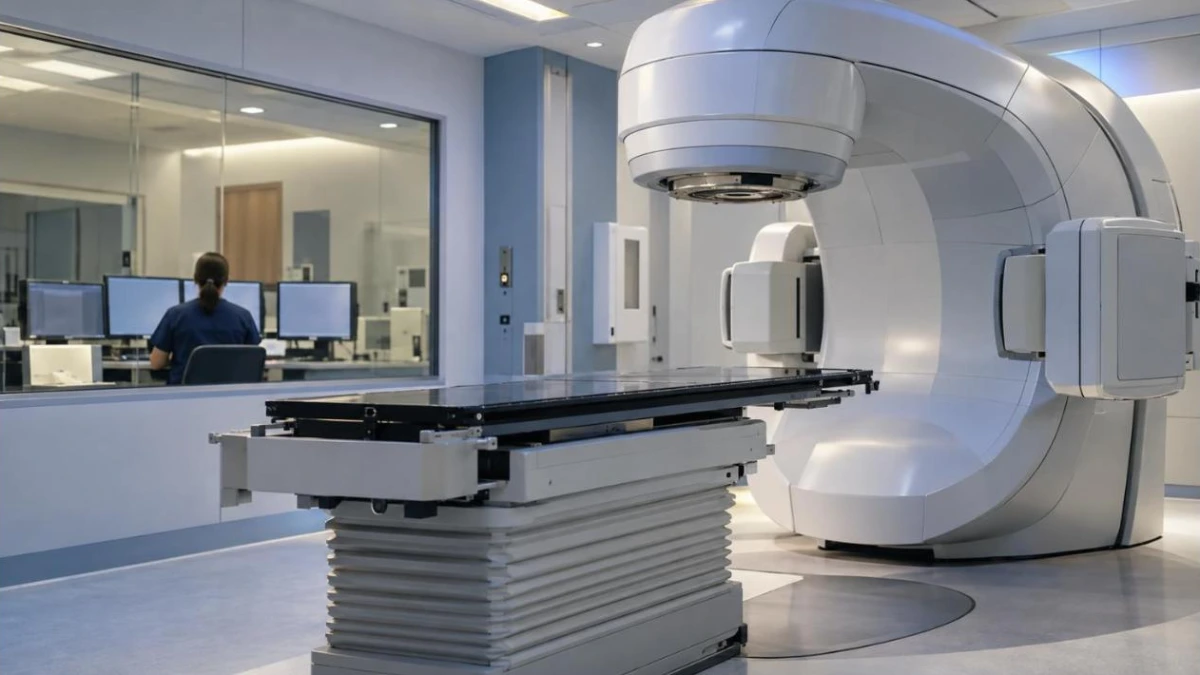
Image credits: both schematic figures are original diagrams produced by MEDIWIN for this article. The photograph is an illustrative image; it does not show a real hospital, team or patient. No third-party image was used or adapted.
Written by MEDIWIN Editorial Team, summarising the published sources listed above. This article has not been reviewed by a colorectal surgeon or an oncologist, and nothing in it should be read as a clinical opinion. It should not be used to choose a treatment sequence, to change prescribed treatment, or to delay urgent medical assessment; those decisions belong to the treating medical team.
This article is general information and not medical advice. MEDIWIN Co., Ltd. is a foreign-patient facilitator registered in Korea (Registration No. A-2022-01-01-4465) and is not a medical institution; diagnoses and treatment decisions are made by physicians at independently operated registered medical institutions.