



Last updated: 16 October 2026 · Written by MEDIWIN Editorial Team · How we selected sources: specialist-society guidelines first, then the randomised trials they rely on; each reference was checked against its bibliographic record and, where the abstract or full text was openly available, against the publication itself.
TAVI vs SAVR is not a choice between a modern and an old-fashioned operation. Both replace a narrowed aortic valve: TAVI (transcatheter aortic valve implantation) places a new valve through a catheter, usually from the groin, while SAVR (surgical aortic valve replacement) replaces the valve during open-heart surgery. A Heart Team of cardiologists and cardiac surgeons weighs age and expected lifespan, the anatomy of the valve and arteries, other heart disease and surgical risk before recommending either [1][2]. For a medically stable patient living abroad, a document-based second opinion is normally the first step rather than travel. Anyone who faints, has chest pain at rest or becomes severely breathless needs urgent assessment where they are, not a plan to travel.
Key points
- The 2025 European (ESC/EACTS) guideline recommends TAVI for patients aged 70 or older with a tricuspid (three-leaflet) aortic valve when the anatomy is suitable and access through the femoral artery is feasible [1].
- Randomised evidence in patients younger than 70 is limited, and the European guideline generally favours surgery for them when surgical risk is low. For a bicuspid (two-leaflet) valve, TAVI is a weaker option that may be considered when surgical risk is increased and the anatomy is suitable [1].
- The 2020 American (ACC/AHA) guideline recommends surgery for patients younger than 65 or with a life expectancy of more than 20 years, transfemoral TAVI for suitable patients older than 80 or with a life expectancy of less than 10 years, and either procedure after shared decision-making for symptomatic patients aged 65 to 80 who are suitable for transfemoral TAVI [2].
- In selected low-risk patients, randomised trials found TAVI non-inferior to surgery for combined outcomes that included death and stroke, with follow-up now reaching seven years in one trial. The complications differed: fewer serious bleeding and atrial fibrillation events after TAVI, and more pacemakers and more leakage around the valve with some TAVI valves [3][4][5][6].
- Durability beyond about ten years is less certain for TAVI valves than for established surgical valves, which matters most for younger patients who may need a second valve procedure later [1].

Who MEDIWIN is, and what it does not do
MEDIWIN Co., Ltd. is a foreign-patient facilitator registered in Korea (Registration No. A-2022-01-01-4465) and is not a medical institution. MEDIWIN provides administrative coordination only: at the patient’s request it can transmit submitted records to an independently operated registered medical institution, and arrange scheduling, interpretation, the visa letter and travel-related support. MEDIWIN does not recommend a procedure, determine whether TAVI or surgery is suitable, diagnose a condition or provide treatment.
Any medical opinion is issued by that institution’s physician, not by MEDIWIN. A document-based opinion is provisional; it is not a diagnosis or a final treatment plan, which are determined by the treating physician after assessment in person. Coordination is available to people aged 18 or over living outside Korea.
What aortic stenosis is, and why the valve is replaced
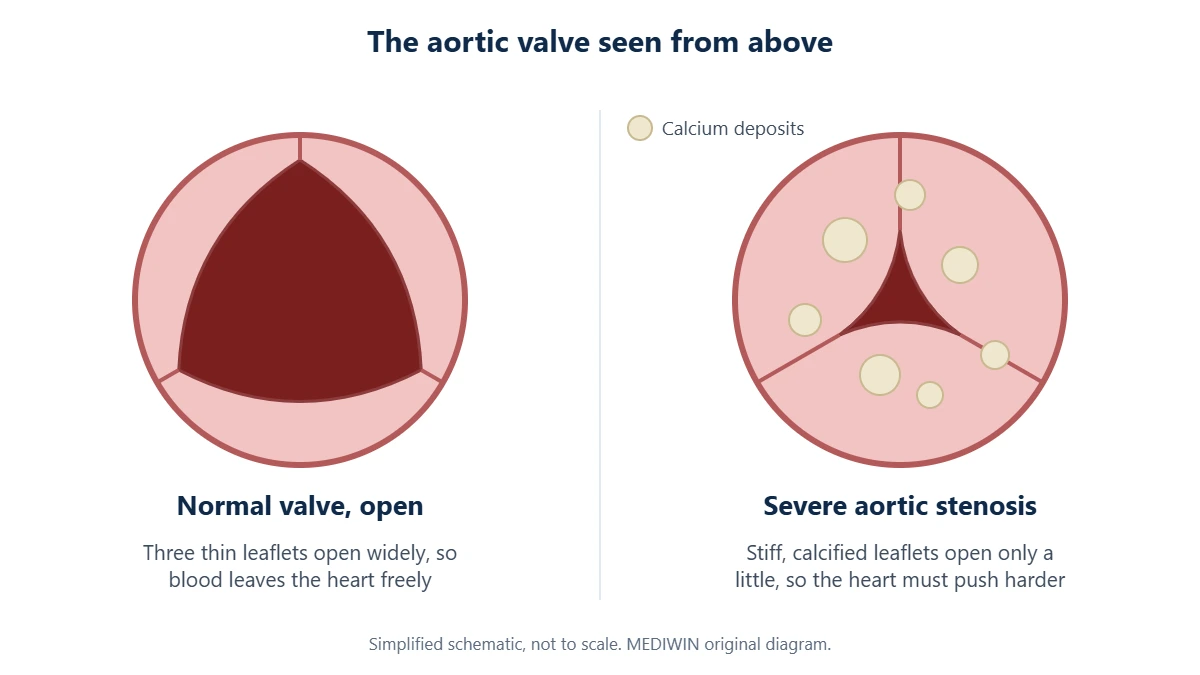
Aortic stenosis means the aortic valve, which lets blood leave the heart for the rest of the body, no longer opens fully. In older adults the leaflets usually stiffen with calcium; in younger adults a valve born with two leaflets instead of three (a bicuspid valve) is a common cause. The heart has to push harder through the narrowed opening. Once severe stenosis causes symptoms such as breathlessness on exertion, chest pain or fainting, both guidelines recommend replacing the valve unless the procedure is unlikely to bring meaningful benefit. Replacement may also be advised in some people without symptoms, depending on heart function and other findings. No medicine reverses the narrowing [1][2].
The question for the Heart Team is therefore usually not whether to replace the valve but how. TAVI and SAVR both use a new valve; they differ in how it is put in place, in their short-term risks, and in how much is known about the long term.
How the Heart Team weighs TAVI and SAVR
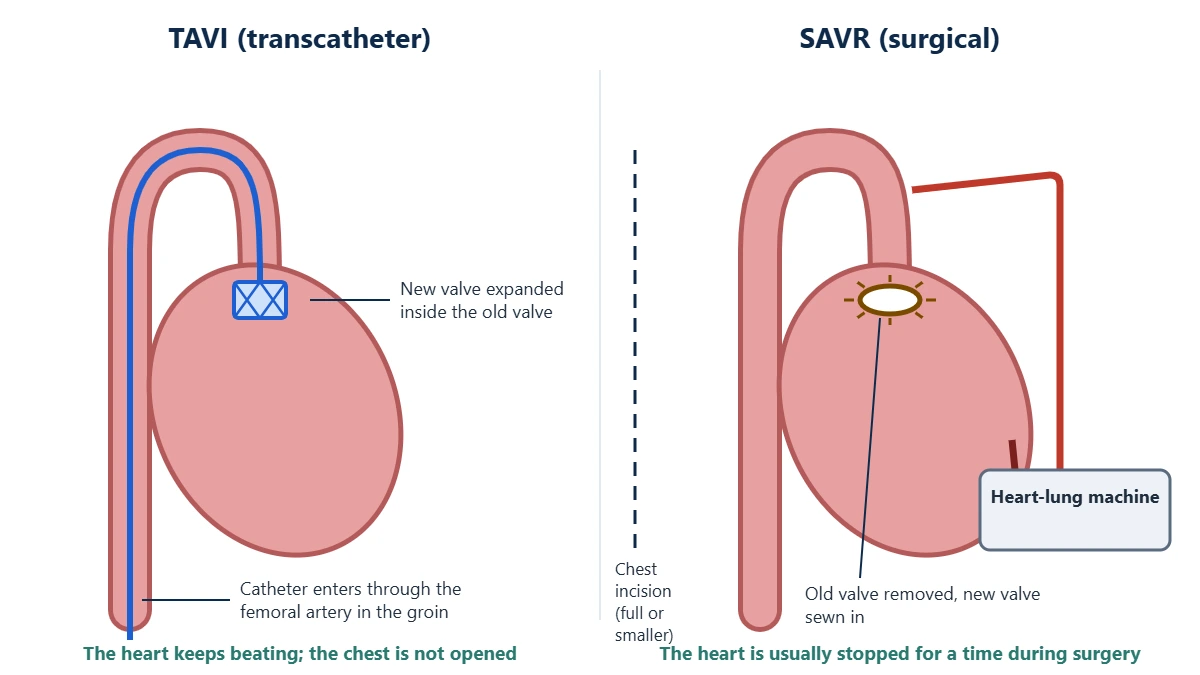
In TAVI, a collapsible tissue valve is guided through an artery, most often in the groin, and expanded inside the diseased valve, which is pressed aside rather than removed. The heart keeps beating and the chest is not opened. In SAVR, the surgeon reaches the heart through a full or smaller chest incision, usually stops the heart temporarily with the patient on a heart-lung machine, removes the diseased valve and sews in a new one, which may be a tissue (biological) or a mechanical valve. Surgery also allows other problems, such as narrowed coronary arteries or an enlarged aorta, to be repaired in the same operation [1][2].
| Situation | Option usually favoured | What mainly decides |
|---|---|---|
| Age 70 or older, tricuspid valve, femoral access feasible | TAVI, recommended in the European guideline [1] | Valve and artery anatomy on CT, other heart disease, frailty [1] |
| Younger than 70, low surgical risk | Surgery, because randomised data in this age group are lacking [1] | Life expectancy and the likelihood of needing a second valve procedure later [1][2] |
| Bicuspid valve | Surgery is generally favoured in younger, low-risk patients; TAVI may be considered when surgical risk is increased and the anatomy is suitable [1] | Valve shape, calcium distribution, the size of the aorta, surgical risk [1] |
| Severe symptomatic stenosis with high or prohibitive surgical risk | TAVI, if survival of more than 12 months with acceptable quality of life is expected [2] | Whether valve replacement is expected to improve symptoms and quality of life [2] |
| Other heart disease needing surgery (for example, extensive coronary disease or another diseased valve) | Often surgery, so that all problems are treated in one operation [1][2] | Coronary anatomy and the severity of the other disease [1][2] |
The American guideline uses age bands: it favours surgery for patients younger than 65 or with a life expectancy of more than 20 years, transfemoral TAVI for suitable patients older than 80 or with a life expectancy of less than 10 years, and either procedure after shared decision-making for symptomatic patients aged 65 to 80 who are suitable for transfemoral TAVI [2]. The European guideline, published in 2025, lowered its age threshold for TAVI from 75 to 70 years; age is one factor among several, and life expectancy and the chance of a later second procedure are weighed alongside it [1].
What the trials show, and what they do not
Two large randomised trials compared TAVI with surgery in patients at low surgical risk. In PARTNER 3 (average age 73), the combined rate of death, stroke or rehospitalisation at one year was 8.5% after TAVI and 15.1% after surgery [3]. At five years the difference was no longer statistically significant: 22.8% after TAVI and 27.2% after surgery, with estimated rates of death of 10.0% versus 8.2%, stroke of 5.8% versus 6.4%, and bioprosthetic valve failure of 3.3% versus 3.8% (TAVI versus surgery) [5]. At seven years the combined outcome had occurred in 34.6% after TAVI and 37.2% after surgery, again without a significant difference; death was 19.5% versus 16.8%, stroke 8.5% versus 8.1%, and bioprosthetic valve failure 6.9% versus 7.5% [6].
In the Evolut Low Risk trial (average age 74), death or disabling stroke at 24 months was estimated at 5.3% after TAVI and 6.7% after surgery. In the first 30 days, TAVI patients had fewer life-threatening or disabling bleeding events (2.4% vs 7.5%) and much less new atrial fibrillation (7.7% vs 35.4%), but more needed a permanent pacemaker (17.4% vs 6.1%) and more had moderate or severe leakage around the valve (3.5% vs 0.5%) [4].
These results apply to the patients studied: mostly people in their seventies with a three-leaflet valve and suitable anatomy. They do not yet show how TAVI valves perform after 15 or 20 years, which is why the guidelines are more cautious about TAVI in younger patients [1][2].
Risks of each route
Both procedures carry risk. After TAVI the main concerns are stroke, damage to the artery used for access, the need for a permanent pacemaker because the new valve sits close to the heart’s electrical pathway, and leakage around the valve. After surgery the main concerns are bleeding, infection, atrial fibrillation, kidney injury and a longer recovery after opening the chest. Tissue valves placed by either route can wear out over time; mechanical valves last longer but require lifelong blood-thinning treatment [1][2][3][4].
Which records a Korean team needs
- The most recent echocardiography report and, where possible, the images themselves on CD or DVD, showing valve area, pressure gradients and heart function.
- Any cardiac CT, especially a TAVI-planning CT of the aortic root and of the arteries from the aorta to the groin.
- Coronary angiography or coronary CT angiography results, if performed. In TAVI candidates, the European guideline allows invasive coronary angiography to be omitted when a good-quality planning CT excludes significant coronary disease [1].
- A recent ECG and any rhythm monitoring, including any history of heart block or atrial fibrillation.
- Recent blood tests, including kidney function and haemoglobin.
- A current medication list, especially blood thinners, and a summary of other conditions such as lung disease, diabetes or previous heart surgery.
Incomplete imaging is one reason a document-based assessment may be inconclusive. A written report without the images may not be enough, because valve and artery measurements often have to be checked directly.
Before travelling to Korea
- Ask your current cardiologist whether you are medically fit to fly. Fainting, chest pain at rest, or severe or rapidly worsening breathlessness needs urgent assessment locally, not international travel.
- Ask what the Korean institution would need to decide between TAVI and surgery, and whether a provisional opinion can be given from documents alone.
- Ask how long the assessment and recovery are expected to take, and what would happen if the plan changes after examination in person.
- Plan follow-up at home: echocardiography and rhythm checks continue after you return.
- Read our heart surgery page and the overview of serious illness treatment in Korea for how cardiac cases are coordinated.
Frequently asked questions
Is TAVI always better because it avoids open-heart surgery?
No. TAVI avoids opening the chest and is generally associated with a shorter hospital stay and faster early recovery in suitable patients, but it has its own risks, such as a higher chance of needing a pacemaker with some valves, and less is known about how long it lasts. For younger patients and for some valve shapes, surgery is often favoured [1][2][4].
I am 68. Can I still be considered for TAVI?
Possibly, but age alone does not decide. The European guideline’s TAVI recommendation applies from age 70 with a three-leaflet valve and suitable anatomy; below that, surgery remains the preferred approach when surgical risk is low, although TAVI may still be considered in selected patients after the Heart Team has weighed surgical risk, anatomy, life expectancy and the patient’s preferences [1].
What happens if a TAVI or surgical tissue valve wears out?
A worn tissue valve can sometimes be treated with a second transcatheter valve placed inside it, or with surgery. Whether that is possible depends on the first valve and the patient’s anatomy, which is why the Heart Team considers the whole lifetime when choosing the first procedure [1].
How do I get a second opinion without travelling first?
A document-based review is the usual starting point. See our second opinion page for what can and cannot be answered from records alone, and our treatment cost page for how hospitals prepare written cost estimates after reviewing records.
Arranging a document review
MEDIWIN can transmit the records listed above to a registered medical institution in Korea and arrange scheduling, interpretation, and support with the hospital-issued documents that a visa application may require. The medical opinion is issued by that hospital’s physician. Please send written records only at first contact, and not through public comments; MEDIWIN will explain the submission method, which institution the records go to, and the consent needed, before any medical documents are requested.
References
- Praz F, Borger MA, Lanz J, et al. 2025 ESC/EACTS Guidelines for the management of valvular heart disease. European Heart Journal. 2025;46:4635–4736. doi:10.1093/eurheartj/ehaf194
- Otto CM, Nishimura RA, Bonow RO, et al. 2020 ACC/AHA Guideline for the Management of Patients With Valvular Heart Disease. Circulation. 2021;143:e72–e227. doi:10.1161/CIR.0000000000000923
- Mack MJ, Leon MB, Thourani VH, et al. Transcatheter Aortic-Valve Replacement with a Balloon-Expandable Valve in Low-Risk Patients. New England Journal of Medicine. 2019;380:1695–1705. doi:10.1056/NEJMoa1814052
- Popma JJ, Deeb GM, Yakubov SJ, et al. Transcatheter Aortic-Valve Replacement with a Self-Expanding Valve in Low-Risk Patients. New England Journal of Medicine. 2019;380:1706–1715. doi:10.1056/NEJMoa1816885
- Mack MJ, Leon MB, Thourani VH, et al. Transcatheter Aortic-Valve Replacement in Low-Risk Patients at Five Years. New England Journal of Medicine. 2023;389:1949–1960. doi:10.1056/NEJMoa2307447
- Leon MB, Mack MJ, Pibarot P, et al. Transcatheter or Surgical Aortic-Valve Replacement in Low-Risk Patients at 7 Years. New England Journal of Medicine. 2026;394:773–783. doi:10.1056/NEJMoa2509766
Image credits: both schematic figures are original diagrams produced by MEDIWIN for this article. The photograph is an illustrative image; it does not show a real hospital, team or patient. No third-party image was used or adapted.
Written by MEDIWIN Editorial Team, summarising the published sources listed above. This article has not been reviewed by a cardiologist or a cardiac surgeon, and nothing in it should be read as a clinical opinion. It should not be used to choose between TAVI and surgery, to change prescribed treatment, or to delay urgent medical assessment; those decisions belong to the treating medical team.
This article is general information and not medical advice. MEDIWIN Co., Ltd. is a foreign-patient facilitator registered in Korea (Registration No. A-2022-01-01-4465) and is not a medical institution; diagnoses and treatment decisions are made by physicians at independently operated registered medical institutions.